
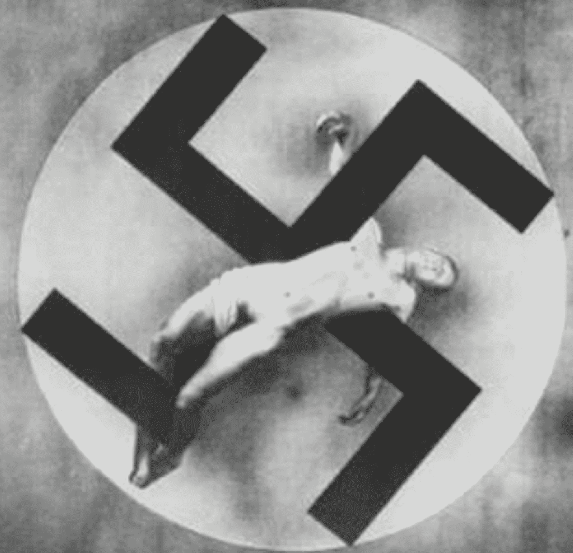
How to Make a Fascist
The dark and dirty, disease-ridden and deathly trenches of the First World War were something new in history: a crucible of camaraderie in the face of terrible odds, awe-inspiring new machinery, and terrifying weaponry – the trenches were a brotherhood moulded by extreme violence. One of those brothers was the German soldier Ernst Junger. At 19 years old, he sustained 14 wounds over the war, and when it had ended he could only make sense of it, he said, if he raised it and gave it some kind of meaning.
Junger died in 1998. He was 102 – a respected author – a voice of that lost generation. His 1920 memoir of the war, Storm of Steel sits apart because rather than just eulogise the fallen, it heightens the experience of war.
Junger represents something that runs all the way through this story – the idealising, glorification, romanticising or at the very least spiritualising or heightening of violence. He wrote this:
‘“In these men there lived an element that underscored the savagery of war while also spiritualizing it: the matter-of-fact joy in danger, the chivalrous urge to fight. Over the course of four years the fire forged an ever purer, ever bolder warriorhood.”
I have never been near a war. But like me, you can probably understand something small about the odd feeling of pride, of bravery, of value that can accompany something negative – a wound, an accident, a challenge, something that’s painful. Imagine that times a thousand – something impossibly difficult in the service of something great, transcendent even. That’s what Junger is getting at. Take this passage:
‘Once again: the ecstasy. The condition of the holy man, of great poets and of great love is also granted to those of great courage. The enthusiasm of manliness bursts beyond itself to such an extent that the blood boils as it surges through the veins and glows as it foams through the heart . . . it is an intoxication beyond all intoxication, an unleashing that breaks all bonds. [In combat] the individual is like a raging storm, the tossing sea and the roaring thunder. He has melted into everything.’
He touches on something we don’t like to admit – we are fascinated by violence. We are culturally hooked on war games, war podcasts, movies and documentaries about war and other types of violence. It’s as universal as it gets. And Junger celebrated the declaration of war in the same way many of his contemporaries did – bored of routine bourgeois life, suspicious of the materialism and decadence spread across Europe and America, desirous of heroism, of something meaningful – sound familiar?
After the war, Junger said that if the war was meaningless, it would be necessary to give it meaning. He wrote ‘The blood of the Great War cannot have flowed for nothing.’
And in a way he was right – even if it was a pointless war at the time, has it not acquired meaning in art, literature, poetry, film, in history? He said that if any type of philosophy saw the slaughter of millions as meaningless, that must be a barren nihilistic philosophy in which no god is present. [walk off]
[walk on] Many of the people we’ll meet in this story have very similar ideas – that violence can have meaning because it moves history – it moved Rome, the British Empire, the American Revolution, didn’t it? It wasn’t philosophers or pencil pushing bureaucrats that moved anything – it was men of action. Aren’t we all a bit too comfy?
Junger, like so many, advocated the overthrow of what he saw as a lying, divided, parliamentary talking shop, weak, decadent, interwar Weimar Republic. He became part of a clique of writers who became known as ‘conservative revolutionaries’ in Germany. He believed in overthrowing German Weimar democracy and believed in a ‘soldierly nationalism’.
He flirted with Nazism and was mildly antisemitic. He called the early Nazi Party ‘revolutionary fire’. And the Nazis – Goebbels particular – loved him. But Junger stopped short of supporting the Nazis in the end. Why do I mention him right at the beginning then? Because he perfectly epitomises the complexities of seeing this story through the lens of simple good guys and bad guys – ambiguous people are everywhere here – Junger was a nationalist who hated democracy but produced great authentic, earnest art. He flirted with fascism but stopped short. But the big reason I start with Junger is the cultural heightening, the idealising, of violence. The historian John Foot says in his book on Italian Fascism – Blood and Power – that ‘violence is a central theme.’
We almost always today, reflectively, think of war, violence, fighting as instinctively bad, evil. But we also respect veterans, play war video games, play soldiers as kids, and will be instinctively violent to protect the things we love. Moreover, we celebrate values associated with war – honour, bravery, strength, sacrifice.
To think about a violent generation requires a recalibration on our part, to understand that violence was a much more ever-present part of life, not just often accepted, but often thought of as good, purposefully pursued. This the first reversal you have to do to understand fascists from our comfortable screens today. Yes, I see you – led down, flicking through your phone, bored. You think it’s all about being captured by Hitler’s spell, Mussolini’s propaganda, that you wouldn’t be tricked – this interpretating of how you might become a fascist is wrong.
You were much more likely to be someone who was already tough, expecting of more war, either experienced or know many who did experience those wwi trenches. We’ll look at many groups that also emerged out of that couldron of violence – shock troops, veterans, squadristi, arditi, Hitler and Mussolini too – and how that combined with a long history of intellectual ideas about the volk, about socialists and anarchists, Darwin and race struggle.
Forget what you know, this is not the story you know, this narrative has to turn what you know upside down – this is a story in which Enlightenment philosophers are evil, order is sacred, violent struggles are inevitable and progressive, fascist villains are heroes, and Europe has been corrupted by the endless blabbering, patronising and pontificating of intellectuals and parliaments. We’re going to go deep into the psychological historical onion. You’ll come away from this knowing the fascist, the authoritarian, the war mindset better than anyone. If we’re going to understand fascism, we have to look into their and maybe our souls.
Fertile Soil & Fascist Seeds
Where to begin? Well, welcome to Berlin. I’m going to argue, in a minute, that this is actually the last place we should begin, but it points to something we want to get at – if we can talk of a soul of fascism, an inner core, a foundation, a starting point, where, who, or what is that? In a moment, we’re going to travel to the countryside, and eventually we’ll join some Italian squads roaming that countryside, looking for action, but for a moment, I want to think about the great historian Richard Evan’s opening line to his Third Reich trilogy: he says ‘Is it wrong to begin with Bismark?’
Bismark ruled over Germany’s second Reich between 1871-1890, exemplifying the ideal of strong, competent, authoritative, forward looking, world-shaping but ultimately conservative leadership.
That’s a lot of words to describe one person. But it already says something to us about the charisma and power of a ‘strongman’. These types of forward-looking self-made – ie not royal – conservative leaders were something new. A reaction to the idea of the world as progressive, innovative, scientific. A reaction to the Enlightenment.
He united Germany, hated parliaments and division, was smart, effective, calculating, negotiated with liberals effectively – he was a revolutionary conservative, a white revolutionary, using the past to strongarm the future – in the 1920s, when the Nazis were rising, many Germans were still alive that lived under Bismark.
Bismark had many of the hallmarks of the authoritarian side of Fascism. But the key difference (amongst many smaller ones) was his elitism. His fear and rejection of the masses. Hitler and Mussolini’s later innovation was not to just rule, control, and preside over the masses but to accept, shape, and use them.
Bismark was remembered by Germans as the Iron Chancellor. But his memory had in some ways become distorted. Bismark had to negotiate with liberals who won concessions like fair trials, equality before the law, a bourgeois capitalist system, the rolling back of most censorship, and the acceptance of some parliamentary power. Bismark was a conservative pragmatist.
Later, in 1944, German diplomat Ulrich von Hassell wrote: ‘It is regrettable how false is the picture which we ourselves have created of him in the world, as the jackbooted politician of violence, in childish pleasure at the fact that someone finally brought Germany to a position of influence again. In truth, his great gift was for the highest diplomacy and moderation. He understood uniquely how to win the world’s trust, the exact opposite of today’
In this sense then Evans could be wrong to start with Bismark. I think we have to go deeper. And remember, we’re not just looking at Germany here.
So where does understanding start? Causes are like dominoes, one topples the other, but you can go back too far. One review of books and journal articles in 2000 counted 37,000 texts on Nazis alone, and that’s before we look at other fascisms. If we’re talk antisemitism we can go back a long way. Maybe you have to look at Napoleon as the first modern dictator, rather than Bismark.
And there’s a big thing to contend with here: that Italy and Germany were very different places. That France was more antisemitic than Germany. Italian Fascism emerged out of a split from the Italian Socialists. Hitler hated Marxists as much as hated Jews. Many other countries had fascist or proto-fascist movements, as far back as the nineteenth century. In Russia, the Paramilitary Black Hundreds were an ultranationalist pro-Tsar antisemitic group with 3000 branches, aiming to mass mobilisation. France had the antisemitic nationalistic and populist Action Francois.
Here’s what a lot of these have in common: the nineteenth century a new, scary, fast-moving, chaotic, migratory, scientific, god is dead world.
We also forget how the national and imperial make-up of Europe looked very different. Nations and ethnicities were scattered and under different Empires. Nation states were not the norm in the world.
This idea of being scattered, say, is not something we think about too much today. Countries in Europe were and still are porous. Germany included millions of Poles, some slaves, Danes, French speakers. The Austrian-Hungarian Empire was made of dozens of different ethnicities. It was also much easier and much more accepted to move around – modernity was speeding everything up.
Bismark gives us a picture of something many feared in the period: chaos overrunning order. The world was moving fast – the industrial revolution, capitalism – by the time we get to the turn of the 20th century – Electrification, engines, telegraph, telephone, cars, plane, cinema, radio – second industrial revolution. There was atomisation, a fear of decadence, of materialism over godliness.
Bismark represents a realpolitik of pragmatic conservative order and slow gradual change. He had a deep respect for the Prussian monarchy, for the grounded, rooted, landed estates and aristocracy, for religion and order, ordained by god.
But new figures – and we’ll get to them – were revolutionary conservatives – they believed in combining the older order with the dynamism and movement of the future. They were Bismark on steroids; Napoleon in a tank; Genghis Khan on the radio.
And in this new and scary period, a few nations were doing very well – Britain, France, America slowly, Germany catching up, but that, along with Italy, both countries had something of an inferiority complex. The Franco-Prussian War had proved Germany’s military might, but where were her colonies? Italy had the glorious past of Rome but what of it now? Chaos and nostalgia are a dangerous combination. The turn of the century was a strange time – much was smashed together. And many were fearful that the West had become unrooted.
The Pure of the Earth
Ok – you’re a woodworker, in a village, life’s pretty good, work is regular. You’re used to working with the same traditional tools, knowledge, and techniques, generation upon generation, taught by your dad and his dad before him. You might have never even seen a guidebook. Suddenly, factories are producing furniture on production lines, they’re being delivered by trains, not just across countries, but across continents, advertised in national colour printed catalogues, managed from a city you’ve never even been to, with cars. If your tool is obsolete – are you? What does that fear of losing your livelihood do to you? You are a good person. A farmer, a builder, a grocer – part of the heartland, not the metropole.
In many ways, the strangeness of science, technology, and the Enlightenment is the antithesis to this. A body of specialist, abstract, esoteric knowledge by antisocial awkward men in ivory towers.
Intellectuals and technocrats that focus on measuring, categorising, mathematising, studying, on empiricism and rationalism – modernity, bureaucracy, universities, advanced industries – a focus on statistic, data, numbers. How much? What length? Which gauge? Which measuring beaker? Which microscope? Which industrial instrument? Cost, demand, supply chains, spending and borrowing, interest rates, loans, growth. To most people, this is alien, abstract, terrifying stuff.
Romanticism ended up being a European wide phenomenon. But in Germany it went deeper and lasted longer. Romanticism treated all of this abstract Enlightenment jargon with suspicion. It contrasted abstractions – up there – with what was rooted – bodies, emotion, community, tradition. William Wordsworth – about as far from a fascist as you might think you can get – said ‘The Man of Science seeks truth as a remote and unknown benefactor; he cherishes and loves it in his solitude: the Poet, singing a song in which all human beings join with him, rejoices in the presence of truth as our visible friend and hourly companion.’
Science, philosophy, technology can be seen to so many as an exotic and remote force. The opposite of being rooted in a village, a community, a knowable network of people. If you’re our woodworker. Yes, of course you measure, calculate costs, use some basic maths – measuring is central to your work it always has been – but it’s rooted in something close, something tangible, local demand is demand, right? Local trees and local trees. You’re less focused on the mathematics of big national figures, and more on who you know, good relations, a contract with the local shops, word of mouth – so much small businesses still rely on today.
Romantic rootedness – against Enlightenment theory – inspired the German volkish movement of the nineteenth century. It believed in a people – with special characteristic, connected to their land, their soil, each other, through language – that there was something special about this.
Friedrich Ratzel was a geographer and an ethnographer – a measurer – of land of place – and of people, of culture. In 1896 Friedrich Ratzel wrote “how could you divorce from the very being [of nature] a Volk which for half a thousand years has worked, lived, and suffered on the same soil.” He coined the term lebensraum – living space – the idea that a people needed space to thrive. He based it on his study of animals migrating, having territory, protecting it.
Ratzel wrote that through the German Landscape “a people inscribes its spirit and its fate as it does in its towns and houses.”
He was building on this incredibly rich and powerful tradition of German Romanticism – this painting – the wanderer over the fog – and the fairy tales of the Brother’s Grimm – who believed that local storytelling was as important as Enlightenment science. All of this makes absolute sense, right? Science and maths – just one part of life – life is a jigsaw – you need all the components – you need community, poetry, connection, religion, culture. Later, a German writer – Otto Gmelin put it like this “A countryside becomes a land scape insofar as it is a coherent whole with its own characteristics. But this can happen only when it becomes the experience of the human soul, if the soul recognizes the rhythm of the countryside as its own rhythm.” Rootedness is about stable, somehwat predictable structure between different elements – including people.
Volkish writers, much like the Brother’s Grimm, loved local myths. They’d find inspiration in Germanic texts or stories like the Edda and the Nibelungenlied. Myths are often misunderstood, I think. Myths don’t just mean untrue. They’re meant as organising metanarratives in the Jordan Peterson sense. It doesn’t matter if they’re true or untrue – they’re models for emulation – about medieval knights, or Jesus, or Norse gods, or Marvel heroes, or even real myths like Mandela or MLK. They are literally larger than life. Germany, as we’ll get to, had a particular fondness for their myths.
All of this grew in Germany in parallel with and as a response to the growth of science, industry, and capitalism. The end of the century saw a flourish of neoromantic poets, writers, and playwrights – this was a cultural phenomenon.
Volkish novels were the most popular novels of the period.
Popert Hermann’s Helmut Harringa (1910) was one of most widely read novels of the period. The hero had blond hair, moral purity, so honest a judge knows that he didn’t commit a crime just by looking at his Aryan face. The young protagonist rejects industrialisation and cities, alcohol, racial mixing, instead choosing a pure volkish life.
The Teutoburger forest was particularly special for the volkish writers. The site where an ancient Germanic tribe beat the all powerful Romans. A popular novel – Osning – followed a Nordic Renaissance of a secret group trying to resurrect the cult whose leader lived in a cave in the Teutoburger Forest. Full of old Nordic gods. These stories were later put on stage by the Nazis
Many Romantic writers had a philosophy of spiritual completeness – that all experiences – rather than reason, or science, or business – make a person’s life whole. Very familiar to us today. The Romantics pursuit of wholeness – a striving – really came out of Hegel’s idea of Geist – the total purpose of the universe and everything, including you, in it.
Hegel talked a lot about striving, reaching, dynamism. I think in some ways there is a kind of insatiability – maybe a greediness – to the idea of completeness – that unstoppable wanting of more and more – not money, but spirit, experience, culture.
Take Eugen Deiderichs – he coined the term neoromantic in Germany – and went on to publish an influential magazine called Die Tat in Jena, the home of Romanticism. He made volkish ideas respectable and was very popular.
But he was the model of this kind of aspiring for wholeness. He was eccentric – liked exotic things – he wore zebra-skin trousers, a turban and hosted Greek wine themed feasts. The historian George Mosse (in his book on the Crisis of German Ideology) says that for Deiderichs ‘industrial materialism was being opposed by a new spiritual vitality.’ He thought Germany should renounce liberalism and organise on corporatist lines – where every profession, trade, body – has its rooted place.
Diedrich wrote that “My view of God is this, that I regard the sun as source of all life.” The rays of the sun represented material infused with the Geist, a visible substance transferring invisible heat.” The swastika, by the way, is a visual representation of the sun turning.
Diedrich wrote about and popularised a lot of the Volkish ideas that had come before him. You can think of the German hero – antihero – Goethe’s Faust too – the model of man wanting, desiring, salivating for new experiences – both German and reaching for something more than German at the same time.
There is this strange tension in some of the volkish writers. Much grounded in the traditional, conservative, rural agrarian. But an interest in proving the greatness by going beyond – to Aryan’s in India to Norse gods – or the Nazi’s obsessions with the holy grail. It’s an attempt to prove wider influence, wider greatness, wider connection.
Take the then Austrian volkish occultist playwright and novelist Guido von List – he was obsessed with hidden meanings, occult symbols, special places, Germanic spirit. He wanted to uncover secret old hidden greatness.
He said, for example, ‘”We must read with our souls the landscape that archaeology reconquers with the spade . . . if you want to lift the veil of mystery [that of the past] you must fly into the loneliness of nature.”’
Von List believed in a lost Germanic Aryan culture that once ruled Europe. And a visionary German strongman leader would come from above and return greater pan-Germany to greatness.
The idea of an Aryan race came from the discovery, in the 18th century, that Indian and European languages had a common linguistic root. The Indian Rig Veda mentioned a noble Vedic people called the Arya or Aryans.
Von List and others took this to point to a great noble Aryan race that came from Germany and moved out as far as India. Italian fascism, as we’ll get to of course, very differently, look back at the glory of Ancient Rome – but both have nostalgia for greatness at their core early on in their histories – a greatness that’s been corrupted. Nostalgia, as we all know, is a deeply strange and powerful feeling.
Guido von List’s ideas were adopted by Alfred Schuler – an influential occultist with a haunting face, who gave talks at a circle in Munich in 1922, which Hitler may have been present at. He led the Munich Cosmic Circle – and further popularised the swastika as a representation of an ancient pure Aryan race – a race which had lost its potency over time through the mixing of blood with other races.
One theme that came out of Volkish writers again and again was this – that if you have a pure model, the pure German, pure blood, the ideal – then that assumes an opposite, the antithesis, the impure.
Antisemitism was European wide. In fact, it was probably worst in France. In most European countries Jews had different rights and had to pay different taxes. But these were gradually abolished across the nineteenth century with Jewish emancipation – the much discussed ‘Jewish question.’ European Jews were often banned from professions and guilds, they were overrepresented as financiers, middlemen and merchants. Because of this, they became scapegoats during financial crashes.
They became scapegoats for national, economic, and religious reasons – the wandering enemy within – the opposite of volkish rootedness.
One of the founders of Volkish thought – Paul de Largard – was both anti-Slavic and antisemitic
Lagard disliked traditional Christianity because of its Jewish influences and sought to Germanise Christian doctrine. He believed the German volk should be organized into medieval estates. The volk should be stable, harmonious, with customs and traditions passed down through the German people. Jews as a stateless wandering people did not fit into this stable harmonious order.
Not all Volkish thinkers were antisemitic. Someone like the philosopher Moritz von Egidy believed the youth had to be educated by Volkish principles. But on the Jewish question he asked how could the minority of some half million Jews in Germany corrupt fifty million Germans?
In most popular thought, though, there was a reaction to both the wandering Jew and the abstractions and destabilizations of the Enlightenment and materialism. Rootedness became the key metaphor – and there were back to the land movements led by thinkers like Willibald Hentschel. The Artamanen – literally agriculture and man – started off as the Mittgart Society in 1906. It advocated leaving cities and starting communes – they were third ways between communism and capitalism. The Artamanen later demanded the removal of Slavic – mostly Polish – labour from the land on the Eastern frontier – and Lebensraum. Himmler was a member and it was later incorporated into the Nazi Party.
In 1895, Vilhelm von Polenz wrote a popular novel called the Peasant from Buttner which Hitler said influenced him. In it, a peasant borrows money from a Jew which he can’t repay. His land was foreclosed and the Jew sells it to an industrialist who builds a factory on the land. The novel closes with the peasant hanging himself in front of the factory: “The eyes which were leaving their sockets stared at the soil, the soil to which he had dedicated his life, to which he had sold his body and his soul.”
All of this literature and culture saturated Germany. Goebbels, for example, had a PhD in Romantic literature. In it Rootedness becomes a struggle -a struggle to protect and a struggle to preserve or recapture some great past. And sometimes rootedness can be the engine of radical expansion – of the search of Lebensraum to protect the rootedness. It speaks to something paradoxical about fascism which will get to. It is both backward and forward looking – a kind of radical or even revolutionary conservatism.
Take this quote, from a book called the secret book or Zwei Buch. It said:
Hitler’s Secret Book. Here Hitler announced: ‘History itself is the presentation of the course of a people’s struggle for existence. I deliberately use the phrase “struggle for existence” here because in truth that struggle for daily bread, equally in peace and war, is an eternal battle against thousands upon thousands of resistances just as life itself is an eternal struggle against death.’
The Science of Struggle
Struggle. Multiple things clashing. Difficulty. Adversity. Inevitability. Overcoming. Max Aman, a high-ranking Nazi said, Hitler ‘takes the view on principle that it is not the job of the Party leadership to ‘install’ branch leaders. Herr Hitler takes the view today more than ever that the most effective fighter in the National Socialist movement is the man who pushes his way through on the basis of his achievements as a leader.’
It’s difficult to overestimate the effect on people of the discovery of bacteria, microscopic creatures you can’t even see, that make you ill, that can kill you. Robert Koch discovered this in 1876. In an era already questioning religious belief, imagine what it was like to suddenly discover there were invisible creatures all around us that make you sick. IT changed medicine, led to a hygiene drive and an obsession over cleanliness. In Jim Crow America adverts showed white people as soap purchasing clean people and African Americans as dirty and diseased. This stuff was everywhere at exactly the time Darwin published On the Origin of Species.
That book sent shockwaves around the world in 1859, Herbet Spencer coined the term ‘survival of the fittest’ – that we are all in a struggle for survival, against each other, against other species, against our environment, against invisible organisms on our skin. Some scholars point to it becoming akin to a European religion, another saying it pervaded most of thought at the time.
Darwin wrote of ‘’one general law, leading to the advancement of all organic beings, namely multiply, vary, let the strongest live and the weakest die’’
One of the most obvious expressions was that the poor and needy were destined to perish and the fit and strong thrive. But Darwin didn’t quite accept this view – he believed that altruism was compatible with natural selection because it would also improve one’s own chances of surviving when altruism was needed for us.
But it didn’t really matter what Darwin thought – many thought it was obvious. Of course, the sick, the infirm, the weak, hold us back – what if a race was made up only of elites? Something like the War of the Worlds, published in 1898, where humans are wiped out by an inferior species, was part of this general widespread cultural fear.
Scientific and pseudo-scientific language about race, struggle, pure, impure, blood, hygiene penetrated into political thought. Take this later quote from Mussolini. ‘’The Socialist Party practices expulsions because it is a living organism. There are socialist antibodies, just as there are the physiological antibodies, discovered by Metchnikoff. If we do not defend ourselves, the impure elements will disintegrate the party in the same way that damaging germs circulate in the blood … and kill off the human organism.’’Mussolini included phrases like ‘struggle for existence’ between different parts of the party.
Some have called Nazism “applied biology’. Others talked of the ‘medicalisation of society.’ Take this 1920 speech by Hitler on the Jews ‘that you can fight a disease without killing the cause, without annihilating the bacillus, and do not think that you can fight racial tuberculosis without taking care that the people are free of the cause of racial tuberculosis’
All of this ramped up slowly over the previous 70 years. In 1905 a German Racial Hygiene Society was founded. There was a Venn Diagram between Volkish thought like the idea of Lebensraum, the special national character, Darwinist survival of the fittest, and Colonialism.
Struggle meant inevitable war to protect and expand the volk. Territory was the ultimate zero sum game. Like bacteriology, the influence of Darwin pointed to the animal kingdom – territory is all – there are winners and losers – lions and gazelle – the weak and the strong.
Think about this – we live in an unparalleled period of history. Never before have national borders been so static, defined, agreed upon. But think about Genghis Khan sweeping across the steppe, the British and Roman and every other Empire growing or shrinking. Think about how porous, vague, indistinct, some ethnic borders are, all across the world. Think about pilgrims, America, growing West. Think about farmers, or estates, or corporations – growing, buying more land, thriving. Thinking in this way is absolutely customary, commonsensical, how natural, how inevitable.
Of course a volk needed space, land, raw materials. Of course Germany and Italy would fall behind if it gave up and didn’t try to catch up with Britain and France. Of course Italy should be embarrassed by its defeat by backwards Ethiopia in 1896 – these are inheritors of the greatness of Rome, the centre of Christianity, or in Germany’s case the centre of learning, sciences, the defeater of Rome, the home of two great European Reichs. Of course these peoples capable of greatness needed metal, coal, crops if it was ever going to secure parity as a great nation.
And neither had the colonies Britain and France had. Germany had Tanganyika, Namibia, Togoland, Cameroon, New Guinea. The German Empire – the one that existed between unification and the First World War, were slowly growing their battle fleet with the aim of keeping up and beating Britain – a great battle in the North Sea seemed inevitable.
Listen to this quote from Mosse about a novel published in 1907: ‘The course of man’s development, Hentschel asserted, was similar to a release of energy potential: history was powered by energy which had been accumulated and stored from the abundant supply of racial dynamism in primeval times. Race was an electric charge, it was dynamic, and it had to be preserved and enhanced by increasing the degree of racial purity.’ In other words, racism did not have the same negative connotations it does today. Race and racism could be a positive force, a force central to the development of one’s own race.
Racialist thinking fused the volkish and social Darwinism to develop into ‘scientific racism’ towards the end of the nineteenth century.
The most influential in Germany was the English racialist Houston Stewart Chamberlain. He had moved to Germany, was popular, loved by the kaiser, and talked about the great struggle for supremacy between the German and Jewish races. The Germans were a special tribe who had avoided racial mixing – all the great thinkers from Greeks, to Jesus, to European art – were Aryan because of that Euro-Indo linguistic root. He said of the Jew that “Their existence is sin, their existence is a crime against the holy laws of life.” Chamberlain later admired Hitler and when he was dying, Hitler visited him, paralyzed, and kissed his hand. He died in 1927.
Another popular racialist was Arthur de Gobineau. He believed in three races – white, yellow, and black (in that order) – and that purity had been diluted by mixing. He was pessimistic that anything could change, believing mixing had gone too far. Purity was the key to racial survival.
Again, how natural this can sound – what happens if you mix up all your food, mix up paint, mix every note of a song, what happens with entropy, with too many voices at once – discordance, disorder – from purity to impurity.
Others like Franz Joseph Gall believed in phrenology – that an inner essence could be measured through outer appearances. That everything could be classified, scientifically, and put in its place. ‘Burger-Villingen actually constructed an instrument, called a plastometer, which purported to measure the geography of a human face and thus the cast of a person’s soul’
Enemies of the Volk
What is a city? With everything imported? No farmland? No natural order? So much anonymity – a city is a mess! What was a merchant? Travelling from town to town? Bringing back alien goods. Uprooted! What was the proletariat? Moving from job to job? Disinherited from the land? What most of all about the Jew? Homeless? Rootless? Not ever European? Not even Christian! Not embedded in a network of Frenchness or Germanness. It’s not a matter of good or bad – we all know a good jew – it’s a matter of belonging!
What distinguishes the new antisemitism from the old is its volkisch (or sociological) and pseudo-scientific component. It’s no longer about religion – it’s a matter of fitting in, quite literally. As one writer of the Nazi period later said: “At a time when the Semites were still searching for their promised land and Romulus and Remus were fighting each other, our fatherland already possessed a settled peasant culture.”
Volkish thinkers would say the Germans live in the forest. They are deep and mysterious. The Jew though? They come from the desert. They are rootless, wandering, shallow and dry. One thinker – Moses Calvary – said that his dreams “ripened under pine trees and not under palms.”
Towards the end of the nineteenth century, in this cultural context we’ve led up to, there were a series of depressions and crashes and recessions and crises of capitalism across the world. The world was changing quickly. People were displaced, migrating. Strikes and threats of revolution are increasing. And remember – the majority still lived rurally.
I often think about the significance of the threat you can’t see. What’s in front of our eyes we miss. Or we’re used to it. We worry about air travel but not crossing the road, driving to work. And it’s easy to scapegoat the person, the threat, the group, that are least visible, least present. If you’re in a work meeting about a crisis and John doesn’t show up – who’s to blame? John! And for most people, the Jew is the one who is both there and not there. Visible – in literature, politics, argument – but rarely physically visible. And it’s so easy to define ourselves against what we’re not – black not white, English not French, rooted not wandering. The other is a blank canvas that all of your fears can be painted on.
We think of antisemitism -as xenophobia more broadly – as purely irrational. But the tragedy of othering is not that it’s irrational, but that there is a dire logic to it. Many Jews – because of their historic prohibitions and restrictions – did gravitate towards being middle-men, merchants, owned department stories or banks, were urban.
And so, when a global depression hits in 1873, 1884, 1890, 1893 maybe you need a line of credit for your woodworking materials, for your farm. Maybe the banker is a Jew, or your friends are. Maybe they extend their lines of credit. Maybe they deny them or call in loans. Maybe the bank crashes. Who’s really to blame for the crisis? The stock market in particular was a symbol of capitalism, supposedly dominated by the Jews, that seemed greedy and incomprehensible to most ordinary people. And in 1880, there was a national petition to remove Jewish people from government positions. Jews were expelled from societies and student bodies. By the turn of the century, antisemitism had become so fashionable that one school boy in 1899 wrote that ‘Now, a Jew sitting at the same table with a Gentile excites notoriety.”
Accusations of ritual murder became mainstream. Across these decades, there were 12 ritual murder trials in the Austrian Empire. In France, the Dreyfus Affair erupted when a French Jewish officer was wrongfully accused of spying for the Germans. German politicians won on antisemitic platforms. But as the economy improved the wave of antisemitism died down.
But the mould seems to have been set – in classrooms in particular, volkish, Darwinist, and colonialist thought were popular. Antisemitism was a useful outlet for those who felt something had gone wrong. Many of Hitler’s influences and early circle – like Deitrick Eckart – were artists, poets, playwrights, – who could blame Jewish academies and Jewish control of the arts when their own work went under appreciated.
In Mein Kampf, bringing together the volkish and the Darwinist, Hitler wrote that the ‘The Jews were a ‘pestilence’, ‘worse than the Black Death’, a ‘maggot in the decomposing body of Germany’
Socialists and their Discontents
Italy wanted, no needed, an Empire – like the rest of the great powers. In the second half of the nineteeth century, Italian merchants and forces began occupying what is now Eritrea in Eastern Africa. In 1887, in Dogali, the Italians, with advanced weapons, expected swift victories against supposedly backward Ethiopia. But in what became known as the a detachment of 500 Italians were ambushed by 10,000 Ethiopian warriors. Trapped in the hills, sweltering in the heat, the Italians were slaughtered one by one. It was a national humiliation. There were even riots back home.
Germany and Italy were very different countries. Italy was seen as the weakest of the so-called ‘great powers’ – it was largely agricultural, divided, with little national consciousness. Germany, across the nineteenth century, developed into one of the top three most industrially and scientifically advanced nations on the planet. Italy had high illiteracy, Germany low. But both countries were both unified into single nations around the same time – 1871 in Germany and across the 1860s in Italy. And both were conscious of having some kind of great history to look back nostalgically on. Both had this mix of greatness and insecurity.
Capitalism across the nineteenth century was destabilizing. It offered great promise – technology, machines, materials, weapons – but it was seen to be running away from the volk, the stable, the rooted too. The Enlightenment had unleashed a plurality of competing ideas – liberal, socialist, anarchist – both Germany and Italy were divided about what to do.
By the beginning of the 20th century, the German Socialist Party was the largest political party in the world. It was Marxist but reformist too. It rejected cooperating with bourgeois parties. And, as Evans writes ‘the Social Democratic movement struck terror into the hearts of the respectable middle and upper classes’.
Liberals were making big gains across Europe– parliaments, right, some free speech, larger franchises, some reforms. And so many socialists moved towards reform rather than revolution.
A small group of radicals in France became tired of this. They believed in Marxist revolution. They rejected reform – in fact, many of them hated everything to do with the state, parliaments, and governments. There was a lot of cross-over between anarchists and socialists – and a lot of disagreement. But a new group – syndicalists – believed the state itself was the problem. Power should be in the hands of those that produce, that actually do things. These syndicalists sometimes called themselves Marxists, but they were unorthodox.
What’s surprising, and what we need to explore is this: In his history of Fascism, Stanley Payne writes that ‘The nucleus that eventually founded Fascism in Italy did not, however, stem either from the cultural elite or from the right-wing nationalists, but from the transformation of part of the revolutionary left, particularly the sector known as revolutionary syndicalists.’
Much of our story revolves around that big question – what is to be done – the Jewish Question, The Socialist one, the capitalist one – how do we get on, keep up, move forward. What’s right – a moral question that’s often forgotten when it comes to a system like fascism that seems antithetical to morality at all. But that is the question – what’s the right thing to do. What’s the moral thing to do – when we have talking shop parliaments in Rome disconnected to the peasantry and getting soldiers killed by savages in Africa?
Georges Sorel is key to this story. He was a French syndicalist. And he hated intellectuals, talking shops, liberals – he hated the history of intellectuals too – Socrates yapping and his fellow Athenians sitting around talking abstractions.
He liked Homer – heroes, villains, bravery, action. If we listened to intellectuals, he said, “there would no longer be any soldiers or sailors, but only sceptical and witty shopkeepers.”
Sorel was fascinated by how heroic myths had been central in the history of great civilizations – myths like Homer’s Odyssey and the Iliad. Myths about great Gods from Zeus to Brahma to Thor of knights and chivalry – these were stories that survived, that appealed to people.
He believed that the point of a myth wasn’t about whether it was true or false, but that they were models for emulation, guidance, moral stories that led to results in the real world. Myths could be about the past – to emulate – or the future – to expect.
Sorel wrote that ‘Myths incite action – ‘“When we act, that means we have created an entirely artificial world placed in front of the present and formed out of movements that depend on us. In this way our liberty be comes entirely intelligible.”
The big what should we do question Sorel asked was why are revolutions not happening? Why were Marxists insights about the inevitable collapse of capitalism not coming to pass? Socialists were becoming reformists, collaborating with the enemy! What’s more, Marx believed that the workers had no country – they were united – yet national solidarity was clearly more powerful than international proletariat solidarity. Sorel concluded that the proletariat had failed to fulfil the role Marx had set for them. And that Marx had not foreseen that liberals and the bourgeois could essentially buy off the proletariat, by giving them small morsels of reform, they could stop revolt.
What Sorel thought the proletariat needed – to release them from their only slightly improved chains of industrial bondage – was a great motivating myth – a model for action.
He thought Marx, as a materialist, had underappreciated the effect of ideas, psychology, symbols, stories. He asked, what was the central organising myth that could kick the proletariat into shape – what was the mythical event that would change the world. IT was the myth of the great heroic, general strike – the one that brings all of society to stand still – the one that prepares the ground for revolution. Finally, the proletariat also needed mythmakers – storytellers, leaders, motivators – an elite, a vanguard.
But Sorel differed from Marx in a crucial way: he rejected the idea of a proletarian dictatorship and the centralizing role of the state. Instead, he envisioned a society where producers – organised in unions – controlled the means of production directly—through autonomous workers’ syndicates operating within a market economy led by elites.
His most well-known work – Reflections of Violence, published in 1908 – was immediately popular amongst French radicals and quickly spread across the border into Italy.
Sorel was, like most intellectuals, plugged into that Darwinian culture of the day – the culture of struggle – a culture that had a shared heritage in philosophers like Marx and Hegel. He wrote that “Class struggle is the alpha and omega of socialism.” But the emphasis on struggle was why he thought a type of capitalism was inevitable – it was struggle between people, ideas, production – that was the great engine of change.
Many in Europe on the left and right were worried about decadence, moral decay, laziness, drunkenness, greed. Antidotes of course differed across the political spectrum, but for Sorel, heroism and myth were the answer – bravery, sacrifice, glory, survival, brotherhood, the heroic class struggle against a villainous enemy.
So for Sorel, the general strike was key to all of this. One history I was reading claimed that in 1906, there were half a million strikes. Which seems implausible, but these were years that were the height of unrest. Strikers would share small portions of saved up food, or would go crab fishing and forage, soldiers would shoot at strikers to get them to go back to work. In Russia in 1905 100s were killed on Bloody Sunday. Sorel believed you needed selfless heroes of the strike – brotherhood, solidarity, villains.
Edouard Berth, a syndicalist and student of Sorel, and a follower of Bergson wrote:
‘The strike is a phenomenon of collective life and psychology. Here, very powerful, very contagious, almost electric sentiments come into play. . . .The will of each worker is submerged and absorbed in this unity: individual egoism, private interests, miserable personal preoccupations, and little secret weaknesses disappear. There is now only an electrified mass, a complex collective personality, transported all together with a single unanimous and powerful upsurge to the highest peaks of heroism and the sentiment of the sublime.’
Sorel believed that during a strike violence could “appears as something very beautiful and very heroic,” for “not only can proletarian violence ensure the future revolution, but it seems to be the only means by which the European nations, deadened by humanism, can regain their former energy.”
Sorel moved further away from orthodox Marxist. He hated democracy more than anything. He moved towards nationalism as a carrier of national myths, an organiser of the people, a motivator for action. And again, how true this has been – how convincing this is. Even today, nothing has proven more powerful than national identity.
Sorel wrote ‘“Today it is nationalism that carries the forces of reason and sentiment that will henceforth be responsible for social transformations.” This “ascension of nationalism,” he said, had the result that “one sees national values replacing socialist values in the public mind.”’
In his incredibly detailed book on the history of this, The Birth of Fascist Ideology, historian Zeev Sternhell says this was the key turning point – the point when a radically new type of elite, outside of the economic or liberal elites of democracies, sought to ‘mobilize the masses by means of myths.’ Not only that it was ‘supported by the idea of violence.’ It was anti-Enlightenment, anti-rational, revolutionary – and so contained many of the later ingredients for fascism. Not all of them of course – these were still syndicalists – they believed in getting rid of the state entirely and putting industry in the hands of the unions. But you can see a journey that is beginning to be taken – how some who followed Sorel would slowly move further to the right.
Berth began an influential group inspired by Sorel and the anarchist Pierre Proudhon called the Cercle Proudhon. It was criticised for its contorting of Proudhon’s ideas – but its core belief was a rejection of a parliamentary democracy. It declared:
‘Democracy is the greatest error of the past century. If one wishes to live, if one wishes to work, if one wishes in social life to possess the greatest human guarantees for production and culture, if one wishes to preserve and increase the moral, intellectual and material capital of civilization, it is absolutely necessary to destroy all democratic institutions.’
This is something we’re not used to today – that you can be on the left and antidemocratic, that unions can be revolutionary but still retain their hierarchies. That nationalists and leftist could of course be the same – remember nationalists were often fighting for national freedoms, to unyoke themselves from oppressive empires. Nationalism had very different connotations that it does today. You could be progressive, anti-democracy, nationalist, and socialist all at the same time.
Sorel’s thought was influential on Italy’s trajectory, but not in Germany. Volkish thought in Germany but not in Italy. But if you broaden them out – that there had to be a different way to manage unwieldy capitalism, that the nation, the group, the great power, or the volk had to come first, that struggle was key and enemies inevitable, that myth – national stories, symbols, cultures – was central – you get an idea of a general emerging counter-spirit of the age – counter to the rationalist, materialist, and liberal models of the Enlightenment – and what could me more counter to idea of Enlightenment than violence?
The Cult of the Violent
Mussolini was a clown. At least that’s how history has often remembered him. But this is mistake. He read philosophy widely, spoke 4 languages, left 44 volumes of writing, he loved poetry, music, Russian novels, he was an intellectual, a teacher. But he was also ruthless and violent. He stabbed a classmate in the hand when he was 10. He was expelled for being uncontrollable. He is the most fascinating paradox.
The young Mussolini in many ways embodied everything we’ve looked at so far – he was a committed socialist, read widely, knew Darwin, Sorel, believed in Italian nationhood, and greatness, long oppressed by the Austrians who controlled much of the north of Italy. Even in his early years of dictatorship, so many admired him, from British aristocrats, to many Americans, included Roosevelt, who called him ‘admirable, even to Gandi. There’s an entire book on American sympathy with Italian Fascism.
We think of fascism is hard and violent. But there’s something so key to remember that comes up again and again about the period – it was hard and violent. Even socialism, which was often see as meek and about welfare today, was about violence, struggle, tough industrials. War, authority, repressiveness was a status quo accepted fact of life. And many saw war and progress as intimately connected.
Take the Risorgimento – Italian unification – it was only possible through war – by violently expelling Austria from controlling the north of Italy. Prussian dominated German unification similarly had to expel Austrian Imperial interference around the same time.
Hence Bismark’s phrase blood and iron.
The idea that violence and war are inevitable seems quickly justified by history. Add in Darwinian struggle and you might quickly turn violence from something to be avoided to something to be embraced.
One syndicalist, Arturo Labriola, justified violence by saying this: “In the hands of a surgeon, a sharp blade confers health; in the hands of an assassin, it destroys life.” In other words, a wound, if purposeful, could be a good thing.
Enter the futurists – led by Tommaso Marinetti. They were a movement which emphasised modernity, technology, speed, and violence. If you haven’t read the short 1909 Futurist Manifesto – it’s a must. It talks about the:
We intend to sing the love of danger, the habit of energy, and fearlessness. 2. Courage, audacity, and revolt will be essential elements of our poetry. 3. Up to now, literature has exalted a pensive immobility, ecstasy, and sleep. We intend to exalt aggressive action, a feverish insomnia, the racer’s stride, the mortal leap, the punch and the slap. 4. We say that the world’s magnificence has been enriched by a new beauty: the beauty of speed. A racing car whose hood is adorned with great pipes, like serpents of explosive breath—a roaring car that seems to ride on grapeshot—is more beautiful than the Victory of Samothrace. 5. We want to hymn the man at the wheel, who hurls the lance of his spirit across the Earth, along the circle of its orbit. 6. The poet must spend himself with ardor, splendor, and generosity, to swell the enthusiastic fervor of the primordial elements. 7. Except in struggle, there is no more beauty. No work without an aggressive character can be a masterpiece.’
‘9. We will glorify war—the world’s only hygiene—militarism, patriotism, the destructive gesture of freedom bringers, beautiful ideas worth dying for.’
The futurists were fierce northern Italian industrialists. Think about Italy divided between a backwards agricultural south and these excited energetic technical poet youths in the north.
In 1913 Marinetti wrote “The future needs blood. It needs human victims, butchery. Internal war, and foreign war, revolution and conquest: that is history…. Blood is the wine of strong peoples, and blood is the oil for the wheels of this great machine which flies from the past to the future.”
Take the British Empire – it was both technologically advanced – ships, artillery, – and it had lebensraum beyond its meagre size – Canada, Australia, India, Africa. It had it all through industry and blunt force. It instilled jealousy in all nationalists.
And finally, add Nietzsche, so compatible with the idea of struggle, with Darwin, a figure who also criticised the pen pushers of the Enlightenment – a man known above all for the idea that morals could be created, through a will to power.
Nietzsche and his idea have been blamed, fought over, exonerated over their position in this history – and his work is rich and complex – but his idea of herd morality left behind by an ubermenche forging his own moral path forward could at the very least be adopted by those who had views that Nietzsche himself would have repudiated. He was, for example, an opponent of antisemitism.
So all of this is in the air when the most violent event in human history breaks out: the first world war.
For Italy, the war aims were directed squarely at Austrian control of land perceived to be Italian – the “unredeemed” lands (terre irredente). We have to remember, this struggle over borders wasn’t just abstract – some towns were half Italian, half Slavic, part French or Germanic maybe – nations in Europe are much more porous. And so the politics of struggle in these places could be very material.
But while many welcomed the violence of the war, in Italy for the most part there was still little enthusiasm. Peasants didn’t understand the point – they were often not interested in new ideas like ‘national’ identity. Deserts were executed. Mutinies common. There were around a million military trials.
One historian descries a famously brutal general like this: ‘‘He had 19 men shot in the back for sundry offences on the morning of the 16 November alone, another man, Alessandro Ruffini, was shot for saluting without taking his pipe out of his mouth.’’
And the war in the alps was particularly gruesome – a white war where more died from cold than bullets. Advances were slow or non existent. One advance of 25 miles cost 200,000 lives. Not only was there little enthusiasm, but the socialists were internationalists, proletarians of the world unite!, they weren’t just apathetic but violently antiwar.
In a way, this made the prowar, violent struggle advocates even more pro violence – they doubled down – they argued the peasantry needed radicalising to believe in the importance of a war for their nation.
The war created, in historian John Foot’s words, a ‘violent generation.’ A sacrificial generation too – a generation who, as Junger wrote, struggled and found some meaning in all of this horror. John Foot’s book on Italian Fascism – Blood and Power – reads like an encyclopaedia of violence that arose in many ways from the war. A war that got worse and worse – poison gas, aerial bombing, submarine warfare, flamethrowers, amputations.
Payne writes ‘The virtually static trench fronts tied down millions for months on end, creating a new collective consciousness of a separate society, a warrior group partially isolated from the rest of the nation and from normal experiences’
Take the infamous Italian Arditi – meaning ‘the daring ones’ – they were elite shock troops, some of the most feared in the war, trained in hand to hand combat, dagger combat, explosives – these were the ultimate men of violence.
And they brought this camaraderie home with them – they resented shirkers and deserters and socialists – and the pacifists and internationalists in turn hated them.
Ferruccio Vecchi was one of them. He wrote after the war ‘‘We would like to thank the army and apologise for the fact that we did not all die as was our hope and our duty.’’ He was a key figure in the early squadristi– groups of fascists that banded together to fight socialists. In other words, fascism emerged out of these groups. Remember those words – arditi and squadristi – the movement from bands of brothers at war to bands of brothers at home is crucial here.
The German experience was just as shaped by the violence of the war. There were groups fighting in trenches in France that were suddenly told they’d lost. How was that possible? No-one had invaded Germany! Not only that, after their loss, the German fleet, submarines, tanks, guns, and military equipment had to be given up. Its territory shrank by 13% (plus 10% of population). The Allies took ships, trains, over 100,000 coaches, coal. Plus the Germans had to be reparations and accept ‘sole guilt’ for the war.
Were the terms harsh? German terms were planned to be harsher. Evans writes ‘the reparations bills that Germany actually did have to pay from 1919 onwards were not beyond the country’s resources to meet and. not unreasonable given the wanton destruction visited upon Belgium and France by the occupying German armies.’
So the forces coming home believed they’d been stabbed in the back by weak, capitulating internal traitors back home. Germany quickly descended into a spate of mutinies, revolutions, street battles, abdications – that it was a country in everything but civil war. Allied troops occupied this strip of the Rhineland for most of the 20s.
Resentment filled veterans returned from the front to find liberal and socialist revolutionaries on the streets attacking them – street fights broke out immediately. Those veterans had learned order and belonging in tight-knit hierarchical units. They organised, they took army courses, they sometimes adopted antisemitic, volkish, or rationalist ideas.
One veteran remembered ‘As I was limping along with the aid of my cane at the Potsdam station in Berlin, a band of uniformed men, sporting red armbands, stopped me, and demanded that I surrender my epaulettes and insignia. I raised my stick in reply; but my rebellion was soon overcome. I was thrown (down?), and only the intervention of a railroad official saved me from my humiliating position. Hate flamed in me against the November criminals from that moment.’
After a friend was assaulted another remembered that ‘The red rabble, which had never heard a bullet whistle, had assaulted him and torn off all his insignia and medals. We screamed with rage. For this kind of Germany we had sacrificed our blood and our health, and braved all the torments of hell and a world of enemies for years.’
Inflation hit Italy and Germany hard almost immediately. Groups like the Steel Helmets formed to provide financial support for struggle veterans. It quickly rose to 300,000 members, then a million. They organised marches and demonstrations – one in Berlin had 132,000 Steel Helmets marching in uniform. They said “The Stahlhelm fights for the German Volk and therefore for the renewal of the Germanic race; it fights to strengthen German self-consciousness so that foreign racial influences will be eliminated from the nation.” The Fatherland Party was pan-german and had over a million members. These groups mostly had a natural affinity with volkish groups.
The Conservative parties realised that they might be able to get the great masses, the mob, on their side. That the working-classes weren’t just destined to support liberals, socialists, and communists. Some conservative politicians became more focused on antisemitism. Knuppel Kunze has known as ‘Kunze with the stick’ – because he attacked Jews so much. A coalition was emerging around veterans, volkish groups, and conservative politicians.
These veteran groups were aligned with the many youth groups, teachers, and boarding schools that had sprung up and were mostly organised on Volkish ideas – The Bunde – places where the special rooted character of Germanness united with a feeling of eros between a tightly bonded group of men. The Thule Bund, organised in 1918, was formed to fight supposed secret Jewish organisations and plans. Many countries had something similar but analyses of German textbooks have shown the volkish principles to be particularly strong amongst middle-class teachers teaching German kids.
Mosse writes ‘Modernity was universally and irrevocably condemned; the spirit of the Germanic forebears, the primitive but heroic inhabitants of the Teutonic forests, were held up as examples to be emulated’
Hermann Lietz taught at this English boarding school near me in the nineteenth century. He admired the English system. Mosse writes that ‘There, while a guest teacher, Lietz observed the work of Dr. Reddic as he directed his educational institution under the motto: “Education spells Empire.”’’
The English system concentrated on Anglicanism – essentially volkish Christianity, English history and greatness, and physical prowess. Lietz went back to Germany and founded the first German version in 1898. Boarding schools are the perfect place to mould kids with an ideology with hierarchy – in this case that Germany needed to reject the Enlightenment and build something special, something German.
Lietz’s successor, Alfred Andreesen, became a national socialist and Mosse says ‘praised the Adolf Hitler School as the culmination of Lietz’s work.
Mosse writes ‘To a large extent, all of these factors coalesced co create the new martial and heroic feeling of the soldiers returning home. The war and the events resulting from it had infused both the Bunde and the Youth Movement with a renewed spirit of national consciousness.’
These paramilitary organisations became so large and powerful that political parties began associating with them, courting their support, aligning with them. Some groups had ultra-violent offshoots that practiced revenge killings against communists.
The working classes were poor and more likely to support communism, the middle and upper class saw what had just happened in Russia and became increasingly scared of revolution. Germany seemed on the brink of becoming Soviet.
A 1919 uprising in Berlin was quashed and its communist leaders Karl Libknecht and Rosa Luxemburg murdered. At least a thousand were killed in regional civil war. Another uprising in Hamburg in 1923 was similarly violently repressed
Another paramilitary group – the Free Corps – had over half a million members, would assassinate opposition leaders, fight against communists, and march on the streets. To put it simply, the militarisation of war had returned to the streets. These men were instutionalised. There were so many of these groups for radicalised, traumatised, and bored veterans. One was called the ‘association against the arrogance of the Jews.’
The communists had the Red Front-Fighter’s League. The Free Corps, Steel Helmets, and others would fight them for control of neighbourhoods. One historian called it ‘‘quasi-guerrilla warfare’. One young Nazi called them the ‘red murder mob … the screaming, screeching hordes … hate-filled, furious faces worthy of study by a criminologist’
In his book, The Coming of the Third Reich, Richard Evans writes ‘It was in this atmosphere of national trauma, political extremism, violent conflict and revolutionary upheaval that Nazism was born.’ Some called the Free Corps the vanguard of Nazism.
You cannot overemphasise the importance of the war. Either you were in it or you knew many that were. Friends, family, neighbours dead or wounded. Borders changed. Debt, inflation, yes, but also, the militarisation of huge parts of society. Authority, hierarchy, propaganda, industry and homelife geared towards war aims – total war. Fascism rose from the paramilitary violence on the streets. Evans says ‘‘Without the war, Nazism would not have emerged as a serious political force’.
There’s story after story of brutal violence, and we’ll get to more/ But for the moment, the fragile middle held.
When Things Fall Apart
What does it mean to be modern? We’ve seen the rejection of the Enlightenment – of abstract ideas by thinkers sat in disconnected universities or libraries talking about made up things like rights – this was everywhere – feminism, abstract art, communism, parliaments talking about right to speak, to associate, to print. All of this supposedly above traditional heroism, feeling, rootedness, order and hierarchy. What else does it mean? Materialism? Factories? Consumerism? A collecting of pointless stuff over the cultivation of spiritual values? All of this abstract art, the radio, the jazz clubs, the dancing, – in cities, with the homeless, the rootless, the Jewish – and what about the Bolsheviks? Jewish Enlightenment nonsense – madness – red terror. Many across Europewere scared and disorientated.
The Russian Revolution had been brutal – white terror against Bolsheviks turned into red terror in retaliations – hundred of thousands died. Bela Kun led a short-lived Hungarian Soviet Republic in 1919 in Hungary – initial red terror turned to white terror when Kun’s communist regime was overthrown by monarchists. In Germany, a Bavarian Soviet Republic was declared in 1918, lasting around a year – In 1918-1919, Europe looked like it could turn red entirely.
The Kaiser fled and the parliamentary SPD – social democrats – proclaimed a liberal Weimar Republic – a constitutional liberal republic with a powerful president. It was, from the beginning, despised by both communists on the left and monarchists and nationalists on the right.
Weimar liberals were widely blamed for losing the war. Millions of children grew up without fathers. Many who did come home couldn’t work from an injury, a missing arm or leg or two – pensions and welfare were being paid to almost a million veterans. Germany borrowed a lot of money during the war with no guaranteed means of repaying it.
In Bavaria, the communists under the playwright Ernst Toller then Lenin ally Eugen Levine, trained an army of 20,000 to defend The Bavarian Soviet. But the counterrevolutionaries of Free Corps soldiers were stronger and better trained – 35,000 of them headed to Munich in an armoured train.
They quickly quashed the communists in a bloodbath – communists were beaten, tortured, and executed – the defence of ‘shot while trying to escape’ is a phrase that comes up a lot in fascist violence. 500- 1000 were killed.
Evans writes ‘Munich became a playground for extremist political sects, as virtually every social and political group in the city burned with resentment, fear and lust for revenge. Public order more or less vanished.’
Another nationalist coup was attempted in 1920 – the Kapp Putsch. Mosse writes ‘Much of the post war Fascist movement was built upon the ideals of youth and activism.’ The Kapp Putsch was supported by 50,000 students and youth group members.
Meanwhile, the Bolsheviks had called for an international general strike in 1919. Over in Italy, the chaos was similar. Liberals were blamed for poor war gains. Debt and inflation were high. Socialists were winning elections and unions controlled large parts of the country. Communist ‘maximalists’ urged joining Russia.
There was a ‘Red Week’ in 1914 – a widespread rebellion that almost turned into revolution. Then the Biennio Rosso – the two red years 1919-1920 were characterised by thousands of strikes, street battles, unionisation – thousands of union workers took direct control of some factories, flying socialist flags – revolution looked near.
In his history of Italian Fascism – Blood and Power – historian John Foot writes that during Red Week ‘‘churches were burned, stations invaded by the mob, barricades [were built] in the streets and “Freedom Trees” [trees or poles carrying flags and radical slogans, following a tradition going back to the French Revolution] were raised in the centre of squares.’
It was pretty much a proto civil war – government lost control of areas of Romagna. In Ancona, one journalist wrote: ‘The population is gripped by panic, there is widespread fear that things will get worse, many people have barricaded themselves in their own homes.’ Every book has story after story of strike or protest, brawls, ransacking of newspaper offices, some assassinations, and endless strikes.
Historian Marco Severini wrote of the Red Week that ‘a good part of central Italy was paralysed and isolated for a number of days, increasing a sense of utopia but also fears, exaggerating the role of agitators and militants who would soon be forgotten, and leaving a tragic trail of bloodshed which would prove to be a preview of the destruction of the world war’.
Back in Germany, hyperinflation was hitting.
The government were quickly fell behind of repayments. They couldn’t pay France and so French troops occupied the Ruhr in 1923. This was deeply embarrassing for Germans living there.
Hyperinflation got so bad that money lost all meaning. Money presses couldn’t keep up and only one side of note was printed. Wages were collected in baskets and wheelbarrows, food prices went up while you were eating.
In 1923 The Daily Mail reported ‘In the shops the prices are typewritten and posted hourly. For instance, a gramophone at 10 a.m. was 5,000,000 marks but at 3 p.m. it was 12,000,000 marks. A copy of the Daily Mail purchased on the street yesterday cost 35,000 marks but today it cost 60,000 marks.’
Welfare payments added to financial pressure. Big business often despised being forced to pay Weimar welfare. Veterans and the unemployed needed supporting. Bankruptcies led to companies buying up competitors and large cartels forming.
Gangs of hundreds roamed the countryside steeling crops. Food riots broke out. Convictions skyrocketed. Prisons were bursting. One prison reported that 60 out of a 100 men sent to them had no shoes and 50 no shirt.
Germans became culturally obsessed with crime stories, debauchery, cheating, and of course, the greedy Jew. The Centre Party spent much of their time fighting things like pornography and contraception. Geroge Grosz captured the chaos of Germany in the 20s – criminality, deviancy, sex, chaos – in a Dada style that captured the abstract modernity that anti-Enlightenment thinkers came to hate.
The average person, remember, and remember to put yourself in this position, does not live in a city, does not listen to jazz, is religious, volkish, does not think about the philosophy of rationality or logic or reason, all they know is that their life is very hard, stories are probably still oral, but violence and criminality is everywhere. You’re doing the same – ploughing the field, building furniture – but no matter what you do you’re on the verge of bankruptcy, maybe starvation. – and all of this – plus the stab in the back – was associated with the weak talking shop of Weimar parliamentarians unable to do anything. Evans says ‘‘Weimar was weak in political legitimacy from the start.’
The Weimar Republic went through over 20 governments in the 14 years between 1919-1933. Many were unstable coalitions. Most people were either conservative and hated Wiemar or were communist and hated it. The Army, Police, and Judiciary tended to prosecute those on the left and turn a blind eye to the right. Even the civil service actively tried to thwart parliament
We think of parliament and democracy as normal. This was not. It was brand new, and it was failing. What good are debates and arguments – again, the talking shop – when you need a doer. Many people had memories of a more stable past. If you were a teenager your grandparents remembered Bismark. Remembered more settled and agrarian lives – more predictable. Surely, we should go back?
Because this isn’t an ordinary narrative of fascism, forgive me for playing with time a little bit. But fast forward ten years in Germany and the great depression hits with the memory of hyperinflation fresh in the mind. People were out of work for years. Millions homeless. Evans writes that ‘Informal hiking clubs and working-class youth groups easily became so-called ‘wild cliques’, gangs of young people who met in disused buildings, scavenged food, stole to make a living, fought with rival gangs, and frequently clashed with the police.’
In 1932, 1 in 3 Germans were unemployed. That’s 13 million people including their families
The great and sad irony of the welfare state is that the more an economy fails, the more people need help, and the less the state can help because tax receipts reduce. Communists made huge gains in membership but many of its members were jobless. There were hunger marches across the country. Evans talks about the communists being rich in members but poor in resources. They had communist bars that had to be closed – street battles for territory continued.
Ask yourself this – if you don’t like the chaos of liberalism and are fearful of capitalism, but you don’t like communism and you see what’s happening in Russia, what are the alternatives? Hereditary monarchy seems for the world of yesterday. How can well-working order be made from this chao?
One answer was corporatism. There is a convergence here in volkish and syndicalist thought – both liked corporatism. And corporatism doesn’t mean what it does today. It basically means society organised into neatly defined interest groups with different roles, as a reaction to individualism.
Political scientist Philippe Schmitter defined it like this: ‘a system of interest representation in which the constituent units [i.e., social and economic sectors] are organized into a limited number of singular, compulsory, noncompetitive, hierarchically ordered and functionally differentiated categories, recognized or licensed (if not created) by the state and granted a deliberate representational monopoly within their respective categories in exchange for observing certain controls.’
Sorel for example believed in a syndicalism that would get rid of the state entirely and replace it with well defined corporations run by the unions. Volkish groups often believed in a third way between socialism and capitalism – where each rooted group had its place in the German order – and they were often expressed in utopian novels or in some cases real communities.
Moller van den Bruck believed in a German socialism that was a synthesis of medieval corporatism and German volkish thought – rejecting Marxism because “every people has its own socialism.’ One colony called Eden was founded on corporate volkish principles in 1893.
Even mainstream German s economics was unique – German economists were often opposed to laissez-faire individualism. Economists like Adolf Wagner advocated for the Volkswirtschaft – a ‘people’s economy’ – which involved rationalising industry with state intervention – German states often nationalised trains, utilities, mining, and some industry.
But all of these ideas were floating around in a sea of chaos – socialism, volkism, syndicalism, anarchism, nationalism, authoritarianism, monarchism, imperialism, democracy, liberalism, debt, repayments, crime, street violence, paramilitary groups – chaos needs a hero.
Heroes and Villains, Villains and Heroes
So we have purity, rootedness, volkishness, the affirmation of struggle, the legitimisation of violence, the paramilitarisation of civil society, we have crisis and decadence to be fought, the failures of reforms and parliamentary democracy, we have nostalgia for the glory days – we have myth and symbol. Put all of these elements together and you have a powerful set of values.
There’s an ongoing historical debate – did fascism emerge from below, from the streets, or was it a product of ‘great’ men leaders like Hitler and Mussolini from above – did they fashion the members or did the historical forces fashion them?
Historians come down on different sides on this. But what I’ve tried to lay out is a kind of social, economic, cultural, and political soup – different elements swimming around disparately – without shape. It’s this that might be seen as most relevant to our times – so much change, materially, technologically, ideologically – but no-one quite understanding it, no one giving shape to the unwieldy forces around. Something like an orchestra of instruments without a conductor. I see it like this – the historical forces come first, like Lego, but it takes a leader, a personality, a heroic figure maybe, or least a group, to put them together into something coherent.
Hitler was obsessed with Wagner’s operas for this reason – they were Germanic and heroic. Wagner was the epic German mythmaker. His most well-known work – the ring cycle – brings together elements of Germanic and Norse mythology into a great heroic epic. Germany had had a particularly strong Middle Ages mythical heroes, as well as the ancient ones. The mythic theorists believed having these myths was so important to society. We think we’re past this today but think about the influence of Lord of the Rings, Harry Potter, these aren’t just fictions -they’re structuring myths.
One of the biggest reversals you’ll need to do to understand fascism, the most difficult, is to reverse the heroes and the villains – if you and your people are destitute in amongst all of these ideas, amongst and maybe from these paramilitary groups, from the war, leaders, models to follow, heroes emerge. We have to do what comes most difficult to us since WWII – really try and see ourselves as swimming in these forces – and seeing heroes where we now see villains.
The first thing you need to make a hero is charisma. You need a compelling protagonist. I want to emphasise something else too – charisma is everywhere. We often look at history from figures like Hitler or Mussolini first. But this history is full of minor characters who have hundreds or thousands of followers.
I’ll point to two here. Gabriele D’Annunzio and Karl Luger. There are, of course, many others. Some historians see D’Annunzio as the first fascist. After WWI, he led 200 soldiers into Fiume, a city which today is part of Croatia but had a large Italian population and was under the Austrian Empire. Informed by his ultranationalism and irredenteism – that Italian ideology that pursued ‘unreedemed’ or ‘occupied’ Italian lands, they occupied the city and declared an Italian state of Fiume.
Many seem him as the father of fascism because he brought together many of those initial elements – the ultranationalism, the pursuit of a ‘greater’ Italy in areas ethnically Italian, and crucially he was a poet that knew the power of symbols and slogans, ceremonies – they wore black shirts, idealised violence, and even used the roman salute.
In Germany, Hitler was inspired by Karl Luger – the antisemitic and populist mayor of Vienna – and Dietrich Eckhart, the founding member of the DAP – German Workers Party – in 1919, among others. Eckhart was a volkish poet, playwright, antisemite, and introduce Hitler to authors like Chamberlain
The point here, is that these charismatic figures take on historical forces, sometimes build them up, sometimes innovate, other times not, but often pass them on to a new generation.
And very occasionally, those forces fit with personality, charisma, at the right time and the right place – to create what Hegel called world historical figures – those that move history structurally but also through their personality – putting their footprint on the world
People were always commenting on Hitler and Mussolini’s eyes. Mussolini’s masculinity. Mussolini’s biographer, Richar Bosworth wrote that ‘followers would remark on his ‘inimitable and incomparable’ command of gesture, continuing that ‘‘Mussolini had ‘more than one voice, or rather spoke with a variety of timbres and tones’ — they varied from the sweet and intimate to the stridently powerful – ‘which recon firmed the plurality and multiplicity of his soul’.’
I think it’s in personality and charisma that we do find the greatest challenge to the Enlightenment. It cannot be quantified, it’s not a mathematical formulation, it’s not a type or genus that fits in the model of an Encyclopaedia, the great figures – the heroes and villains – of history are singular. Philosophers like Levinas have pointed to the magic behind the eyes- the person who escapes all of our standard and routine and expected ways of categorising – someone who because of that can outwit, or even just avoid, the rhythms of the expected ways of doing things, convention, the radical who can thwart the pressure to conform to the status quo.
Mussolini was very aware of a comparison to Napolean – a world-shaping figure. Hitler had himself portrayed in portrait as a knight. These men were both, whether we like to admit or not, poets in their own ways.
As we’ve seen, writers like Junger and the Conservative Radicals of the interwar period saw those who fought in the war as a kind of elite with a special connection. Pilots were widely seen as modern knights in armour and serious celebrity cults emerged around them, like the German WWI fighter ace the Red Baron, said to have shot down 80 planes – the so called aces-ofaces.
Mussolini in particular understood the intellectual, cultural, and social heritage before him. And he combined it with an intoxicating love for futurology and technology. He loved engines, cars, planes, learned to fly, survived a crash. Bosworth writes ‘Flying had something viscerally Fascist or Mussolinian about it as man flew heavenwards to challenge the very gods.
Mussolini believed very much in the heroic struggle theory of history – his early Marxism and reading of Darwin taught him of struggle as engine of change.
Writers like Arthur Bonus believed Nietzsche was the self-fashioning knight that had taught Germans to overcome the mundane sheep crowd. Similar to Sorel, he believed in mythmaking, in legends, to spur people into action.
The syndicalist Edouard Berth wrote that a “revival of heroic values that appears to be taking place among the younger bourgeoisie.” “Undoubtedly,” he continue, “something has changed in the bourgeoisie. . . .The bellicose and religious spirit is triumphing over the pacifistic and humanitarian spirit.”
Like Nietzsche, Berth wrote he wanted to destroy “the power of the average, that is to say, of democratic, bourgeois, and liberal mediocrity (as Nietzsche said, the proper word to qualify whatever is mediocre is liberal).”
I’m jumping ahead a bit but as fascist groups formed, mythmaking was key. Myths were constructed around martyrs that had been killed in street fights with communists. In Italy fascists would organise grand funerals lined by thousands of fascists. If we think of Sorel’s mythmaking as not just a story, but the symbols, songs, clothes, the culture that went with they myth, then fascism was the ultimate in utilising this – the Roman salute, the myth of the November criminals that stabbed Germany in the back, the Nuremberg Rallies, the uniforms, the using of modern transport and places, the posters, the poems and songs the propaganda machine. Later Goebbels complained the liberals were copying the Nazis – but it was too late/
Evans writes ‘Goebbels and his propaganda team aimed to overwhelm the electorate with an unremitting barrage of assaults on their senses. Saturation coverage was to be achieved not only by mass publicity but also by a concerted campaign of door knocking and leafleting. Microphones and loudspeakers blasted out Nazi speeches over every public space that could be found.’
For all of these men, in the interwar period, action was prioritised over the stultifying thought and talk of rationalism and the Enlightenment. Violence over peace. Nationalism over internationalism. Heroes over democracy.
Mussolini admired. Thomas Mann on Hitler.
An Idea of Fascism (Just a Bundle of Sticks)
Just 2 years before the war, in 1912, Mussolini became editor of the socialist journal Avanti! He was the foremost socialist in the country. He was a committed revolutionary Marxist. And what I will say about Avanti! Is it aesthetically, it went hard.
The biggest question mark, the point of analysis, the moment of crucial importance for me, is how Mussolini turned from socialist to fascist. I think anyone on the left would be perplexed by this move. But the key to understanding it is national identity.
Remember Sorel’s emphasis on myth, story, action as a mobilising force? Well just before the war Sorel became a nationalist syndicalist – somewhere between Marx, Prouhon’s anarchism, and nationalist ideas. The key thing to remember here is that nations – with distinctive cultures, languages, heritages – were under the yolk of empires. Imagine being one of the hundreds of thousands of Italians that live under Austro-Hungarian rule in the north of what is now Italy. Of course we should be uniting Italians, of course Italians should be free, self-determing, one. In other words, nationalism was in many ways a progressive cause.
On the other hand, when Italy was united in 1860, only about 2.5% of ‘Italians’ even spoke Italian. The peasantry had no real idea about Italian national identity, history, greatness, goals.
So almost everyone except the internationalist left believed that fostering and incubating this national culture was key to Italian greatness. On top of this there’s the national empire question – What happens when France and Britain carve up Africa and leave you nothing. Belgium had the Congo. What did Italy have? Fragility. Did it not deserve a seat at the imperial table? Some said the ‘least of the great powers.’
IN 1904, Mussolini had attended lectures by Vilfredo Pareto – one of the most famous intellectuals of the period. Pereto believed in ‘creative elites’ – those who shaped the world by will, dynamism, and intellectual creativity. Famed now for the Pareto principle, that 20% of people produce 80% of the results, Pareto believed that elites inevitably ruled. Remember, many believed that the proletariat were failing in the revolutionary mission Marx had set for them. Nothing was happening except ‘socialists’ were giving into to liberals in accepting reforms. They were becoming puppets of the elites.
Mussolini was a maximalist – he believed in revolution over reform – but he was also growing sceptical of the revolutionary power of the working class and tired of the reformist tendencies of so-called socialists. He wrote ‘We only hope that the party returns to its primordial methods of struggle, and that it directs an implacable fighting spirit against the constituted order, without ever dirtying its hands … with political or financial deals.’
Many radicals agreed.
For Syndicalists, Sternhell writes, ‘Little by little, the centrality of class struggle in the credo of the movement was replaced by elitist conceptions and a hope of raising the “moral level” of the working class.’
There was a syndicalist party – the USI (Unione Sindacale Italiana). It was a major force, and had 100,000 members by the end of 1912. It won seats in parliament and slowly, especially over the red years, became more nationalistic.
Mussolini was moving slowly away from the determinism and materialism of Marx. He believed in the power of ideas, in will, in the need to cultivate Italian national identity. He encouraged Italians to read Nietzsche in Avanti!. He wrote in one article ‘it is faith which moves mountains because it gives the illusion that the mountains move. Illusion is, perhaps, the only reality in life’.
Above all, Mussolini hated parliament, the talking-shop – he believed action was key to change.
Sternhell writes that ‘In Italy the synthesis of nationalism with revolutionary syndicalism was based on the same principles as in France: on one hand, a rejection of democracy, Marxism, liberalism, the so-called bourgeois values, the eighteenth-century heritage, internationalism, and pacifism; on the other hand a cult of heroism, vitalism, and violence.’
A similar move will be made in Germany. The founder of the German Worker’s Party – 1919 – Anton Drexler was a socialist. But a national socialist. While there was less of a syndicalist influenced and more of a volkish one, the move made is similar: once you appendage ‘nationalist’ you invite the particular elements, symbols, ideas, myths, poems, music, of your own national culture as a mobilizing force.
For most Marxists nations are an idea – flags, symbols, language. National socialists often agreed but believed that was fine – or they believed, as in Germany, that nations were more than ideas, they were transcendent – mystical maybe.
Either way, national socialists in Italy and Germany began reversing the usual Marxist materialism – they believed you put the idea of the nation first.
One nationalist wrote ‘“The nation is above classes,” he declared, “and all considerations of class should give way before things of a national character.”’
The Summer of 1914 changed everything. First, in June, was that red week we talked about, and second, in July, the first world war broke out.
The war split the left in Italy. The Italian Socialist Party – the PSI – were internationalists. They believed, as Marx had written, that the working man has no country. They were the second biggest bloc in the parliament – and Mussolini was a member. The position was neutrality. Mussolini wrote ‘The Italian proletariat must not spill a single drop of blood for a cause which was not its own.’ He wrote in favour of ‘absolute neutrality.’ He did though begin to allow supporters of joining the war to publish in Avanti! But always the unorthodox Marxist, he tentatively started to change his position. He was, after all, by inclination, a fighter and he kept watching the proletariat fail. They were, he thought, poor revolutionaries – something that requires violence. He was beginning to see the war as a chance to radicalise the masses.
Not only most socialists, but most Italians supported Italian neutrality. However, the pressure from those who wanted expansionism – mostly from the center the right – saw a great opportunity. War was also a chance to regain those lost lands – the “unredeemed” lands, the terre irredente – plus maybe a little colony somewhere.
Mussolini edged towards this position.
He wrote ‘’We have the privilege of living at the most tragic hour in world history. Do we – as men and as socialists want to be inert spectators of this huge drama? Or do we want to be, in some way and some sense, the protagonists’?’ It all aligned with his view of action over idea.
Many socialists thought about this question, so it wasn’t fringe. One disagreed with Mussolini, writing, ‘Let the governments blow up the ship! The explosion will sweep them away! Down with war! Long live the Revolution!’
I want to introduce this wonderfully moustached character briefly – Alceste De Ambris. Remember when we talked about charisma, heroism, leadership – this guy was a major figure in the Italian Syndicalist movement. And he’s great because he demonstrates the ambiguities of the left and right at this time. He was on the left – he moved from socialism to syndicalism, believing using the state was a waste of time. The proletariat should win power through unions. But he was an interventionist. He supported D’Annunzio in Fiume, wrote the constitution, which guaranteed free press, thought, equality, equal vote, free schools – again, a man on the left – but a nationalist left. In fact, he founded a very short lived national syndicalist splinter group in support of joining the war – Fascio Rivoluzionario d’Azione Internazionalista. And this attracted none other than Mussolini.
So at this point these two men are both pretty left – the only difference, it would be a left focused on Italy rather than an internationalist movement, and a left in favour of a revolutionary war, and again, remember, there are Italians under the Austrian empire. So you could see this is a war for liberation.
Sternhell puts it like this: ‘The myth of the revolutionary war was an instrument of political mobilization and a call for action to take society out of its immobility. The revolutionary syndicalists therefore denounced all those who opposed the war, whether liberals, reformist socialists, or anarchists, as conservatives’
But there was a crucial difference between the syndicalists and the socialists. The syndicalists believed you could kind of fuse the bourgeoise and the proletariat into one class – the producer class. Sternhell says that ‘it now appeared that they not only regarded themselves as heirs to the bourgeoisie, but preferred sharing with it a wealthier society to inheriting from it a poorer one. This was the essential reason for their anti-bolshevism.’
De Ambris wrote “Bolshevism, which causes the collapse of the bourgeois eco nomic regime, disintegrates every productive organism, creates disorder in the industrial sector, and leads to disorder and poverty; it is the most antisocialist and most antiproletarian phenomenon in the world.”
Remember, these were idealists in a sense, rather than materialists – people who believed in culture, ideas, leaders, myths, symbols.
And Mussolini was again moving closer and closer to this position. He wrote he wanted ‘to create an “Italian Soul” He wrote ‘’In loving their own nationality, it is not mandatory for them to hate the others [Rather] harmonic development and the brotherhood of all nations — this is the socialist ideal’’He wanted his cake and to eat it, too – he wanted to be a socialist and a nationalist.
Things started to move quickly. He continued writing and speaking in support of nationalism. In October he stepped down from Avanti!, in November he was expelled from the socialist party, and in December he gave this speech:
He said ‘The nation has not disappeared… Class reveals itself as a collection of interests—but the nation is a history of sentiments, traditions, language, culture, and race. Class can become an integral part of the nation, but the one cannot eclipse the other. The class struggle is a vain formula, without effect and consequence wherever one finds a people that has not integrated itself into its proper linguistic and racial confines—where the national problem has not been definitely resolved. In such circumstances the class movement finds itself impaired by an inauspicious historic climate’
He immediately began a new paper: Il Popolo d’Italia
But he addressed socialists in it, saying ‘Whatever happens, you won’t lose me. Twelve years of my life in the party are or ought to be sufficient guarantee of my socialist faith. Socialism is in my very blood’’
But he became, like the syndicalists, an anti-Marxist. In 1918 the paper dropped its socialist label and replaced it with ‘producers’.
He was never a member of the syndicalist party, but like converging roads, the two slowly met.
Sternhell writes ‘At the moment the war broke out, the ideological development of revolu tionary syndicalism had reached the point of no return. The socialist-national synthesis had come to fruition in the years before August 1914, but it is clear that this terrible ordeal greatly accelerated its evolution.’
Again, all of those forces drove along those converging roads – the nation, the myths, the symbols, the idea of struggle and the glorification of action and violence – they all culminated in Mussolini accepting the draft in 1915. He served too years, was wounded by shrapnel. AT around the same time, Hitler was temporarily blinded by mustard gas serving in the first world war. Both figures became part of that symbolic generation. Those that had sacrificed, that had served, heroically for the nation. Again, you don’t have fascism without WWI.
Fascism Developed
The development of Fascism isn’t easily understandable because it isn’t straightforward. In many movements you have a set of ideas – Marx’s, say, or civil rights – then leaders – a Lenin or an MLK – than followers.
But with fascism, you have groups on the ground – mostly those veterans returning from war – leadership that is strong minded but without a single set of doctrines, more of a personality – and those two things – the leader and the groups – sort of move closer together.
Remember the Arditi – A’Annunzio, blackshirts, slogans, the veteran groups in german? Many of these, and many others, saw the government in Italy and German as weak – true – and banded closer together to fight international socialists in defence of Italianism.
Bosworth says of the Arditi that ‘At the front, they had intrepidly engaged in the ‘gymnastics of war’; in peace, they would want ‘little formal discipline, no bureaucracy, the most flexible of hierarchies’. Manly in every sense, they fused thought, beauty and action; a new aristocracy, they were the enemies of traitors wherever they might hide’
Another key moment – along with Mussolini’s change – was happening in the countryside around the Poe Valley in the north. In many areas of Italy, socialists were de facto in control, and there was very real class warfare – both ideological, in strikes, and often in real violence- between landowners and workers.
Many came back from the war disillusioned, radicalised by violence, and led by their former officers, joined groups that became known as the sqaudristi or squadrismo in the countryside. They were groups of 30-50 men, much better at organised violence than the socialists, militarily trained, roaming the country, looking for fights. They often poured caster oil on their enemies, utilised army trucks, military weapons. Violence rapidly spread.
Fascist squads armed themselves with cudgels and trucnheons. They are moswtly clean shaven. In black. Many have guns. Leaders became known as the ras. They were all soldiers from the war. Thye went out on ‘expeditios’ finding targets, some times for days on end in trucks
Payne writes that ‘The new mass Fascism had not been created by Mussolini so much as it had sprung up around him in the rural areas of the north.’ The historian Cesare Rossi argued that everything about fascism came from below, from these groups, or from D’Annunzio and his men.
On top of this, these men were often supported financially by the landowners.
But we have to remember than fasci means bundle of sticks because at this point, they weren’t really following a formed ideology. They were groups roaming and fighting – they were nationalist, italianist, anti-bolshevist, militarist mostly – so there’s an outline forming – and some might by syndicalist or have syndicalist sympathies – but remember, many syndaicalists were much more firmly on the left, while many others moved more to the nationalist right but still retained the radical socialist unionism. It was, to understate it, not simple.
ON top of this, fasci was just a general term in Italy adopted by many groups as far back as the 1870s. But in immediate aftermath of the war it became more closely connected to these groups. And as Mussolini moved towards them, like magnet to intellectual ideas, they moved towards leaders and Mussolini.
In The Fascist Experience, Edward Tannenbaum puts it like this: ‘Although many squadristi leaders were to accept subsidies from the big landowners and businessmen, they did not abandon their ultimate goal of making their own revolution. A number of the ex-revolutionary syndicalists in the original Fascist movement were to play a major role in organizing counterunions of agricultural workers, but by the end of 1920 Mussolini began taking his cues from the squadristi’
IN March of 1919, it came together officially at the Fasci Italiani di Combattimento in Milan. Led by Mussolini, he rejected political parties, called for a national revolution, for universal suffrage, for the abolition of the senate, eight-hour work day, worker participation into industrial management, pension plans, and the ‘PARTIAL EXPROPRIATION of all wealth’. In other words, it still sounded very economically and socially left. But it was a syndicalist left.
One syndicalist theorist – Sergio Panunzio wrote a ‘program of action’ at the same time which had articles like ‘Article 5. The entire population be divided into “organic classes.” Article 6. The classes be organized into corporations. Article 7. The administration of social matters be transferred to the corporation’.
Sternhell writes ‘Owing to the fact that each person was a member of a syndicate-corporation, the nation would be made up of syndicates and no longer of individuals solely concerned with their personal profit.’
Later, syndicalist then fascist Agosto Lanzillio said the aim was to ‘reconstitute [the proletariat] on the basis of spiritual liberty, and to animate it with the breath of creative violence. This would be the true revolution that would mould the forms of the Italy of tomorrow.”’
But there was a problem. Most on the left were still socialists. And the squadrismo were funded by large landowners, which Mussolini tried to keep a secret. Remember, this is someone who had just said socialism was in his blood. This is another difficult ambiguity. When did he change? Had he changed yet? Commentators noticed that as far back as 1914, he’d began getting a taste for expensive hobbies, horseriding, cars, nice food. His biographer, Bosworth, jumps around on the issue – was he tainting himself? Maybe. Was he corrupt? Bosworth doesn’t think so. Maybe a double game? OR more likely, a new commonality.
Mussolini himself wrote ‘’Every state-owned concern is an economic disaster’’ He hated the chatter of parliament. ‘’as far as economics is concerned, we are liberals, because we believe that the national economy cannot be usefully entrusted to collective or governmental and bureaucratic organisations’.
Remember, he was anti-state, anti-parliament, anti-bolshevist, and so the only route seemed to be through the unions and corporations.
Mussolini wrote ‘The state turned into a ‘Moloch’, he declared, when it tried to be ‘a banker, a lender, a gambling-house keeper, a seaman, a bandit, an insurer, a postman, a railway-worker, an impresario, an industrialist, a teacher, a tobacco shop-owner, a judge, a gaoler and a taxman’.
Bosworth writes ‘The Fasci, Mussolini explained, were indeed committed, eventually, to a solution whereby land was acquired by those who worked it. However, any move towards greater social equality would be slow. It could only be achieved with national agreement and so without any damage to the economy’
Mussolini said that the ‘hour of syndicalism’ had arrived – a third way between capitalism and communism, of pragmatism – producers and hardworkers, loyal to Italy over class division.
In other words, Mussolini was becoming a kind of pragmatist mongrel – he could do or say or promise anything, as long as it was in service to some nebulous idea of Italy and Italians. On top of this, he was now riding a wave of sqaudrismo, a wave no-one could completely control. I’m not sure there’s reason to see him as a corrupted or cynical figure – in many ways, his principle of Italianism led the way, but in doing so he was becoming all things to all people, and so nothing to anyone. Which is why, right here, might be the beginning of totalitarianism – the idea that the will of the leader counts, a kind of personalist pragmatism justified by an Idea of Italy and supported by extreme paramilitary violence.
As that violence intensified, the fascist groups got bolder, and the country was descending into what looked like either civil war or revolution – the extremes battling on the streets and an ineffectual centre able to do very little. Skirmishes took place all over Italy.
In 1920 Mussolini, endorsing the violence, wrote that ‘’The reality is this. The socialist party is a Russian army encamped in Italy. Against this foreign army, Fascists have launched a guerrilla war, and they will conduct it with exceptional seriousness.’’
The futurist Marinetti and fascist leader Cesare de Vecchi marched to the Avanti! Headquarters and sacked it.
What’s incredible about this situation is that socialists were still dominant in elections. But those elections were then often interrupted by fascists with beatings, gun shots, and general intimidation. One eyewitness recalled ‘‘It seemed like it [the piazza] was covered in bodies which were lying everywhere… it was absurd, hard to believe … apocalyptic ….’
IN many cases, fascists bullied elected officials out of office. The police often ignored what was happening, or took the side of fascists. High profile socialists were kidnapped. One was forced to march around town with a placard around hie neck reading ‘‘You must serve the fatherland and I am a deserter’’
This, in the phrase of one historian, was a ‘terrorist dictatorship’ emerging from the streets. It was a government by violence, forcing democracy out by force. Leaving shadow groups as blunt objects ready to take over. One on looker said they were crazy – ‘it appears that the war has taught people to kill.’
Then violence reached parliament:
Here’s John Foot: ‘Misiano, a deputy since 1919, was sitting in the so-called ‘transatlantic’ corridor in parliament outside the chamber, when the fascist deputy Silvio Gai came up to him. ‘Are you Misiano?’ he asked. Misiano replied in the affirmative. ‘Then get out,’ said Gai. Misiano refused to leave, saying that he had been voted in to serve as a deputy. Gai stated that his voters had elected him to kick Misiano out. Gai then attacked Misiano. After the familiar battlecry, ‘Fascisti! A Noi! ’ (‘Fascists! It is down to us!’), a number of armed fascists, including Giuseppe Bottai, surrounded Misiano and began to push him towards the exit.’
Terror reigned. Socialists retreated. People in fear. The writer Serafino Prati wrote ‘the newspapers of the labour movement are set on fire in the piazzas. Consumer cooperatives are burned and agricultural leagues are dissolved, while they – the fascists – kill and laugh, laugh and kill’”
The leading socialist, Giacomo Matteotti talked in parliament about what was happening. He said it happened in the dead of night, in small villages, houses of union officials would be surrounded by 20-100 armed men, threatening to burn the house if they don’t come out. Then they take him off, torture him, mock-murder him, sometimes release him, other times kill him. IN 1924, Matteotti was bundled into the back of a car, stabbed, and his body dumped outside Rome.
By 1921, fascist groups de facto controlled the streets in much of the North. And in November of 1921, the paramilitary group was transformed by Mussolini into the PNF – the National Fascist Party. There were around 222,000 members, taking many from the socialists whose membership declined.
One socialist wrote ‘Town after town, destruction, threat and terror has hit the sixty small municipalities of Polesine. One by one, and in about two or three weeks, they have been invaded by hundreds of hooligans during the day, beating all those who have been indicated as being socialists by local agrarians, ransacking buildings, breaking up the furniture and taking away everything they find. At night, moving in groups, wearing masks and holding muskets, they shoot at random in the streets and throw bombs, break into the houses of whoever is part of a municipal administration, of a league, of a cooperative and so on and, surrounded by the unspeakable screams of women and children, they threat, violentano, extort declarations, impose shameful things or force people to desperately run away in the countryside’
Fascism had arrived, all but officially.
German Copycats
Hitler was one of the likely majority of Germans who despised the Weimar Republic. Remember, the interwar settlement, the restricting of the army which Hitler had learned to love during WWI, the hyperinflation, the chaos, the threats and realities of socialist and Bolshevik revolution – and the philosophy of the volk.
One thing that particularly irked Hitler was the military having to negotiate with Soviet councils that were popping up across Germany – some wanted to join Russia – others cooperated with the military to bring some order and oppose Bolshevism.
After fighting in the war, being hospitalised in a gas attack, and having rejected the modern multicultural chaotic city of Vienna, Hitler attended army lectures that were antisocialist, pan Germanic, and volkish.
His superiors were so impressed by him that they made him an instructor. He was sent to nationalist meetings, lectured to soldiers about anti-communism and pan-nationalist ideas. Both Hitler himself and his superiors quickly discover an incredible talent for speaking to crowds. So the army asked Hitler to join the DAP – a small ‘German Worker’s Party’ – to infiltrate and gather information.
The DAP pan-German, nationalistic, antisemitic, populist, volkish, and early on anti-capitalist. The 1920 party program had policies for pension plans, nationalising trusts, sharing profits in key industries, and land reform.
But Hitler quickly became the star of the small party – which only had around 50 members – left the army, and shot up the ranks.
I’m not going to tread tired path here – there are plenty of documentaries and videos about the rise of the Nazi s out there. What’s important for us are those trends we’ve already identified – how they appealed to ordinary Germans.
First, like Italy, first and foremost – the interwar paramilitarisation of Germany. We’ve talked about the Steel Helmets, the Free Corps and communist Red Front Fighter’s League, the ‘quasi-guerrilla warfare’ that was a result.
Hitler and the DAP – which became the NSDAP – the National Socialist German Workers Party – built up the SA – the Brownshirts. What’s key, is how the populist, mass-appeal brownshirts appealed to young Germans looking for belonging. This was a group that reached 4 million members, organised from the ground up, larger than the German army itself. Ernst Rohm, their leader, had ties to those paramilitary Free Corps, and built the brownshirts up into a so-called ‘people’s army’ to protect and fight for the NSDAP. Hitler later said that ‘politics back then was made on the street,’ and that he’d searched in particular for men of brutality. In 1921 he said ‘“We must be strong not only in words, but in deeds against our enemy, the Jew.”
Rohm was a man of mindless violence. The first sentence of his autobiography was ‘I am a solider.’ He loved fighting, brawling, drinking, mysoginising, was contemptuous of civilians, and, and this is key was independent from Hitler – one of the few – because his power came from below, from the SA. Similarly Mussolini was riding the wave of squadristi, somewhat dependent on the regional ras leaders, who in turn were riding the wave of paramilitary violence. One SA slogan was ‘we’ll beat our way to the top”.
In Germany one witness remembers 400 brownshirts turning up to a rival meeting. He said ‘One after the other, our four speakers had their say, interrupted by furious howling and catcalls. But when, in the ensuing discussion, an interlocutor was reprimanded for saying, ‘We don’t want the brown plague in our beautiful town’, tumult broke out. There followed a battle with beer steins, chairs, and the like, and in two minutes the hall was demolished and everyone cleared out. We had to take back seven heavily injured comrades that day and there were rocks thrown at us and occasional assaults in spite of the police protection’
Like Italy, paramilitary violence grew. Communists were beaten and murdered. Hundreds were killed on both sides.
One witness remembers a fight when communists stormed a nazi meeting: ‘Blackjacks, brass knuckles, clubs, heavy buckled belts, glasses and bottles were the weapons used. Pieces of glass and chairs hurtled over the heads of the audience. Men from both sides broke off chair legs and used them as bludgeons. Women fainted in the crash and scream of battle. Already dozens of heads and faces were bleeding, clothes were torn as the fighters dodged about amid masses of terrified but helpless spectators. The troopers fought like lions. Systematically they pressed us towards the main exit. The band struck up a martial tune. Hermann Goring stood calmly on the stage, his fists on his hips’
But like Mussolini, Hitler was riding a wave he tried to steer. That wave was pulling in different directions.
Later, Rohm wanted to use the Brownshirts to replace the army, nationalise industries, and continue the ‘people’s revolution.’; A wing of the young Nazi Party, led by Gregor Stressor, was much more left-wing. All were volkish but some more populist and others more elitist. Some more economically to the left. Later all of them were expelled or murdered by Hitler in the knight of the long knives.
What’s interesting about this moment – and bear with me here – is that radicals were expelled, leaving Hitler somewhat in the centre. His policies were not much different from the conservative nationalists of the period. So what was the difference?
Most people, like in Italy, wanted radical change. But like Mussolini, Hitler did not want to revolutionise the economic base, except for some minor reforms. Some Nazis, like some PNF Fascists, did. But both Hitler and Mussolini became kind of pragmatists. So where would the radical change come from? It would be cultural, institutional, national – to create a new spiritual German – all under threat of authoritarian violence.
Hitler found that antisemitism was the most uniting force to all sides and to the base. It animated the most people. It appealed to all prejudices. Mosse writes that ‘With this issue, Hitler had found the basis for uniting, emotionally and ideologically, the small and fanatical party, an issue which transcended the insoluble problem of nationalism versus socialism.’
Hitler’s revolution for Germany was going to be a cultural revolution. A revolution, in Mosse’s phrase of ‘attitudes and feelings’ – to create a new German defined, most of all, against the Jew who could be both a greedy capitalist and a Bolshevik – the enemy was everywhere.
As a result, Evans writes ‘‘The Nazi Party’s support amongst middling and small landowners skyrocketed. Soon, farmers’ sons were providing the manpower for stormtrooper units being despatched to fight the Communists in the big cities’.
Fascism is ultranationalist populism. The political theorist Roger Griffin called fascism palingenetic ultranationalism – palingenetic meaning ‘national rebirth’ – the renewal of past national glory.
Like the PNF, the rise of the Nazis was fuelled by the terre irredente – that ethnic Germans were living under foreign rule, even occupation – that Germans had been stabbed in the back. That there were enemies within and without – the eternal struggle. If you are struggling to feed your family and see people buying bread with wheelbarrows of money. Would you be part of this movement?
Both Mussolini and Hitler knew the power of propaganda – Mussolini with his background in journalism and Hitler as an artist – inspired by musicians like Wagner and poets like D’Annunzio, they used symbols, slogans, uniforms, rallies, songs, radio.
This is what distinguished fascists from conservatives; fascists targeted and brought in the people – conservatives were elitists and distrusted the masses, who they believed should be led. Mass-movements, they thought, were to be feared as anarchical and base. Fascists, instead, were radical in they accepted you, they invited you in, they made you part of something.
And so over the 1920s the Nazi Party grew into the largest party in Germany. Like Italy, the centre shrank to almost nothing. But the country was so divided that it wasn’t possible to get a majority in the Reichstag. Sessions ended in uproar. In 1931 the Reichstag couldn’t sit for six months. Political power moved to president Hindenburg and his inner nationalist circle who ruled by decree.
What people often miss is that Weimar was almost doomed from the start. The communists on the left wanted to overthrow it and the right – including Hindenburg – hated democracy and wanted a return to the Second Reich. The conservatives though did not have the numbers, and needed the Nazis help.
The route to achieving this was through the Weimar Constitution itself. Through Article 48, the president could bypass the Reichstag and rule by decree, in case of stalemate or ‘emergency’ in the Reichstag, which of course was happening. This was a dangerous clause because of the ambiguity of the word ‘emergency’, and became abused across the Weimar years. The very first social democrat president – Friedrich Ebert – used it 136 times.
Evans writes ‘There were virtually no effective safeguards against an abuse of Article 48, since the President could threaten to use the power given him by Article 25 to dissolve the Reichstag should it reject a Presidential decree.’
Finally, an amendment to the constitution could end Weimar democracy – though this needed two thirds majority.
Government after government and cabinet after cabinet failed to govern. No confidence votes, rules be decree, and other legal mechanisms toppled them. Eventually, at an impasse in January 1933, Hindenburg appointed Hitler as chancellor in an attempt to coopt the Nazi movement. By giving most cabinet seats to his allies like Von Papen, Hindenberg hoped to, as Von Papen put it ‘make Hitler squeak.’
But the rallies that followed looked to be more than squeaking. 18,000 Brownshirts and 40,000 Germans joined a march celebrating Hitler’s appointment.
One onlooker wrote that ‘20,000 brownshirts followed one another like waves in the sea, their faces shone with enthusiasm in the light of the torches. ‘For our Leader, our Reich Chancellor Adolf Hitler, a threefold Hail!’ They sang ‘The Republic is shit’ … Next to us a little boy 3 years of age raised his tiny hand again and again: ‘Hail Hitler, Hail Hitler-man!’ ‘Death to the Jews’ was also sometimes called out and they sang of the blood of the Jews which would squirt from their knives.’
Another saw a man struck by a brownshirt and later said ‘The horror it inspired in me was almost imperceptibly spiced with an intoxicating joy. ‘We want to die for the flag’, the torch-bearers had sung… I was overcome with a burning desire to belong to these people for whom it was a matter of death and life … I wanted to escape from my childish, narrow life and I wanted to attach myself to something that was great and fundamental.’
Communists staged strikes, demonstrations, and countermarched. Brownshirt violence increased. Communists were murdered on the streets. Some were tortured. The new coalition cracked down on freedom of speech, banning social democratic newspapers and communist meetings and press. The courts sided with fascists. And the Communist Party claimed 130,000 members had been arrested and 2500 murdered.
Like in Italy, Fascists had grown such dynamic mass-movement counter-institutions in the paramilitary groups, that all that was left to do was to destroy democracy from within.
Conservatives, Crisis, and Power.
Just before Mussolini took power, the composition of the Italian parliament looked like this. You see two big blocs on either side – the socialists as the biggest party; the centre roughly as the biggest bloc, but divided between many parties and largely ineffectual, and the conservative nationalists, including the PNF, smaller on the right. In the previous election, the PNF had won just two seats.
How do we explain their dominance then? First, this last election was the year before the March on Rome – the PNF skyrocketed to having as many members as the socialists across this period. Second, the socialists largely believed that Italian wasn’t developed enough for a revolution, and so hesitated. And finally, the squadristi used blunt violent force at local elections to intimidate and begin to control local affairs.
To take one example Foot says 40 councillors had been elected in Cremona, but that ‘democratic procedure was completely ignored by the local fascists. They did not recognise elections. In that same month, local fascist leader and ras, Roberto Farinacci, insisted that he be allowed to speak as the ‘forty-first councillor’.’ He told them he had ‘elected himself.’
The politician Claudio Treves told the Italian parliament that ‘‘The state has abandoned all its powers to the avengers. A state has formed within the state. A private army has formed alongside the national army.”
The Nazis later needed to win before the real terror began – although it had started before. In Italy, the fascist terror came before power and led them to power.
IN October 1922, Musolinni told a crowd from Naples, ‘we want to become the state.’ HE continue, to roars of support, ‘‘Either they give us the government or we will take it by descending on Rome.’’
Then, in Cremona, Fascists seized a police station and post office. The fascists began to organise a march on Rome.
The King had a choice – send in the army or accept Fascist rule. One Marshal told the King ‘‘Your Majesty, the army will do its duty; however, it would be we l not to put it to the test.’’
But most said and historians have mostly agreed that the army could have easily stopped the march, if the politicians and the King had the will. One said that ‘‘with the use of martial law, and the deployment of regular armed forces, it would have taken forty-eight hours, or even less, to round up the fascists’.’
But the King – King Emmanuel III – stood down. Many since have debated why – was he weak, afraid of civil war, or did he simply agree with the fascists? We can never know for sure. But the key point is this – in both Italy and Germany, Fascists could not win power without some kind of conservative support.
Mussolini took the night train to Rome – fascists ‘marched’, or drove, or got trains too – many in army uniforms with their medals, and the fascists took power.
But again, it was a strange type of compromise of power – the King still in place, parliament still in place, most institutions left in place. Mussolini threatened and cajoled parliament – particularly the centre – into supporting him, and he took ‘full powers’. Many socialists continued to be beaten, tortured, and sometimes killed, now with immunity. The squadristi had become the state.
Foot writes that ‘A novel and highly effective form of political activity was being experimented with for the first time – a militia party’
In Italy, Fascism existed in hybrid form with the liberal institutions that preceded it. It was not a full revolution – and so required the cooperation of these institutions. The Fascist Grand Council was new and outside the existing system, as was the power of the squadristi, both represented the power of the ras as leaders as regional fascist groups. Historian Alexander de Grand writes ‘the old structures and mentalities survived; Fascists merely became part of the existing system.’
The Acerbo Law was passed as a kind of compromise which gave two thirds of the seats in parliament to the party with 25% of vote – meaning the fascists easily controlled parliament. Elections continued but were a farce – organised intimidation and violence stopped opposition from standing. Slowly, Mussolini castrated parliament and replaced it with the Fascist Grand Council, but this took many more years, and the King was still left in place.
What we see in both Germany and Italy are these kinds of shadow institutions – the squadrisit, the SA, and their leadership, rising up as paramilitary groups, blending in some ways with existing institutions, justified by crisis, and legitimised by conservatives who compromised. The old liberal institutions and fascist power blends together, until the latter eventually replaces the former entirely.
The spark that convinces conservatives to do this – usually cynically and hesitantly – is a crisis or a fear of the left. In key moment after key moment, conservatives, fearful of crisis and hopeful of a return to the old ways, enabled fascists. In Italy, police and courts prosecuted the left and ignored the right. In Germany, ‘patriotic’ crimes like Hitler’s were given usually ignored or given short terms.
The ultimate example of a crisis catapulting conservatives to enable fascists was the Reichstag fire. Remember, Hitler had been appointed by Hindenburg in January 1933.
In February 1933 a young vagabond anarchist burned down the Reichstag in a lone act of protest. Hitler was said to have responded ‘‘This is the beginning of the Communist uprising! Now they’ll strike out! There’s not a minute to waste!’’
He went to Hindenburg who signed a decree limiting rights of the constitution – it read ‘Thus restrictions on personal liberty, on the right of free expression of opinion, including freedom of the press, on the right of assembly and association, and violations of the privacy of postal, telegraphic and telephonic communications, and warrants for house-searches, orders for confiscations as well as restrictions on property rights are permissible beyond the legal limits otherwise prescribed.’
The nazis and police went through lists of communists and trade unionists, arrested, beat and tortured them; smashed their offices, took valuables – 10,000 were arrested, the party was banned
One stormtropper remembered ‘We were prepared; we knew the intentions of our enemies. I had put together a small ‘mobite squad’ of my storm from the most daring of the daring. We lay in wait night after night. Who was going to strike the first blow? And then it came. The beacon in Berlin, signs of fire all over the country. Finally the relief of the order: ‘Go to it!’ And we went to it! It was not just about the purely human ‘you or me’, ‘you or us’, it was about wiping the lecherous grin off the hideous, murderous faces of the Bolsheviks for all time, and protecting Germany from the bloody terror of unrestrained hordes.’
This is a great example of leadership from above and street forces rising up from below. Rudolf Diels, the first head of the Gestapo, wrote ‘every SA man was ‘on the heels of the enemy’, each knew what he had to do. The storm-squads cleaned up the districts. They knew not only where their enemies lived, they had also long ago discovered their hideouts and meeting places … Not only the Communists, but anybody who had ever spoken out against Hitler’s movement, was in danger.’
There was one final obstacle. The Reichstag. There was one more election in March. The Nazis, now funded by industrialists, won more votes but still not an absolute majority. But with the communists banned, intimidated, arrested, and by threatening, bribing, and negotiating with the centre parties, the Nazis found the numbers to get that two thirds of the vote required to change the constitution.
In March 1933, the Enabling Act passed through the Reichstag and enabled Hitler to rule by decree, effectively abolishing the Reichstag. Goebbels celebrated ‘‘The road to the total state. Our revolution has an uncanny dynamism.’’
Democracy was dead.
Money Talks and the Soul of Fascism
There’s something we haven’t yet talked about, but we shouldn’t forget – money. There has for a long time been a trope that fascism is, in communist Georgi Dimitriov’s phrase, the ‘open terrorist dictatorship of the most reactionary, most chauvinistic, and most imperialist elements of finance capital.” That fascism is part of class struggle, an expression of the will of big capital.
The argument usually has three parts: that anti-bolshevism was a driving force; that both Hitler and Mussolini sought to rationalise or corporatise or syndicalise the economy but ended up leaving it mostly alone; and that big business supported both regimes.
But there are problems with this interpretation. First – big business openly preferred traditional conservatives until they had no choice. Most of the Nazis early funding came from small contributions and party membership dues, not from big capital. Finally, some industrialists were nervous about the socialist part of national socialism, even if the reforms ended up being minor.
This is a big topic to get into, but my own view is you can acknowledge the influence of big capital and the bourgeoisie without being reductionist about it being the defining factor.
Many of the trends we’ve looked at – racism and antisemitism, in particular – obviously predate capitalism. Plus the anti-rationalism, volkism, Darwinism, colonialism, the desire for order, and so on, are driven by psychological, social, cultural and intellectual forces that can’t be reduced to economics, even if economics is a major driving force.
To take one example, the historian Fritz Stern writes that “a thousand teachers in republican Germany who in their youth had worshipped Lagarde or Langbehn were just as important in the triumph of National Socialism as all the putative millions of marks that Hitler collected from the German tycoons.”
That said, Hitler did collect millions from those tycoons.
Some, like media magnate, Krupp Steelworks Director, and Nationalist Alred Hugenberg hated Marxism but wasn’t antisemitic, he thought Hitler was too fanatical and potentially a socialist.
But Fritz Thyssen – the Steel Manufacturer – enthusiastically supported Hitler even early on. In 1933 – IG Farben, Deutsch Bank, a Mining Industry Association, along with many others organised by the industrialist Gustav Krupp – as well as steel was the main German Weapons manufacturer – raised a substantial amount of money. Combined with middle class bourgeois support, it’s hard not to see it as a variation on the theme of imperialism as the highest form of capitalism. By the 1930s, the Nazis were better funded than social democrats and the communists.
The sociologist Seymour Lipset called fascist an ‘extremism of the center’ – a revolt of bourgeois shopkeepers, artisans, the middle classes – against both big capital or the financial Jew and the proletariat or the Bolshevik threat – and the Nazis found their early support mostly in that core of the Venn diagram
But while money permeates everything, it isn’t everything. Culture, ideas, charisma, science – Darwin – religion, racism – all sit along side it – along with that most fundamental thing that has also permeated our story – the blunt force of violence.
After the Nazis came to power, Evans writes that the terror was ‘comprehensive in scope’. The Nazis called it ‘coordination’. In the Civil Service, one German remembers ‘swastika badges were already sprouting from the earth like mushrooms after a few days,’
Which is our final ingredient in making a fascist – fear and power, conformity and propaganda. I’ve looked at some of this in a previous video – one of my most popular – why not talk as much about it here? Because, as we’ve seen, it wasn’t required. We want to understand fascism from the bottom-up, at its most fundamental roots.
What we’re interested in is the fascism core, the fascist heart, spirit, or soul. In a way, I think of myself like a cooking channel. I want to show you the ingredients. They go by other names in history – factors, conditions, drivers, historical forces, or simple causes – but I like ingredients because, like a cooking channel, I’ve tried to show you the core basics – its up to you how you interpret them, the weights you give them, the things you think I’ve missed.
But the ingredients at the heart of fascism, the fascist ‘minimum’ as its been caused, or ur-fascism – has been endless debated by historians.
Let’s quickly go through out ingredients.
– Spiritualising or heightening of violence
– Anti-rationalism
– a reaction to the Enlightenment
– Heroism and action over logos, debate or thought
– Myth and story over rationalism and materialism
– Vulgar or social Darwinism – the scientism or struggle
– Ultranationalism and volkishness
– A crisis of capitalism and liberalism
– Authority over freedom
– Anti-bolshevism or anti-universalism
– Order over chaos
– Paramilitarism
– WWI
– Establishment support (money and political)
This becomes quite a list. And it risks fascism becoming that thing that you cannot define but you know when you see it.
The German history Ernst Nolte came up with a six point ‘fascist minimum’ – ‘anti Marxism, antiliberalism, anticonservatism, the leadership principle, a party army, and the aim of totalitarianism.’
The philosopher and writer Umberto Eco came up with fourteen.
And maybe most influentially, the historian Roget Griffin has described fascism as ‘a palingenetic (which essentially means ‘rebirth’) form of populist ultra-nationalism’
To me, they fail to capture that very necessary thing that sets fascism apart from milder forms of authoritarianism – the drive for some kind of expansion driven at heart by the heightening of violence. Violence runs through this story, and it’s hard to see how fascism emerges in all of its dynamic, explosive, conservative radicalism without it. Remember Foot’s quote – ‘violence is a central theme.’
I think fascism comes, in a large part, from a fear of chaos. It is, in some way then, the ultimate form of ideology – it is utopian in that it promises order, glory, national belonging, a place, a leader, a good struggle, a clear enemy. It is a response to chaos. But it requires active, participation, heroic violence, to secure that utopia.
Of course, there’s something of the eternal, universal, transcendent, and timeless in defining fascism in this way. Maybe it’s part of that much broader genre – the struggle between freedom and power more broadly – a new expression of the age-old emperor, the king, the tyrant, the master and the slave.
But it seems much more historical too, right? That it was of its moment, unrepeatable, an anomaly, historicisable. Is this true? Because if its part of an eternal threat, we could still be in not just for a repeat, but something worse. After all, democracy is more abnormal than domination. Empires more common than Republics. Are our days numbered? What does it mean to think about fascism today or fascism tomorrow? That’s what we’ll think about next time.
